|
|
|
|
PHOTO TOUR -- 50 PHOTOS
Buddhist Art in Early Japan
BUDDHIST SCULPTURE IN ASUKA ERA 飛鳥時代 (538 - 645 CE)
BUDDHIST SCULPTURE IN HAKUHO ERA 白鳳時代 (645 - 710 CE)
BRONZE RULES THE ROOST
GREAT AGE OF GILT BRONZE ART
THIS IS A SIDE PAGE. RETURN TO PARENT MENU
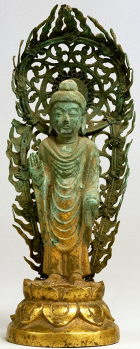
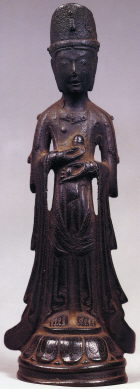
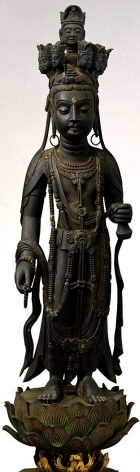
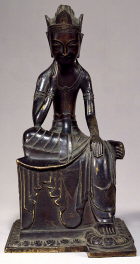
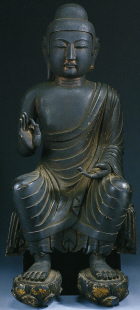
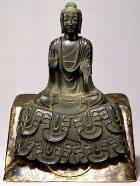
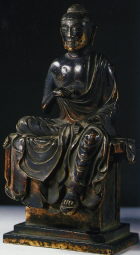
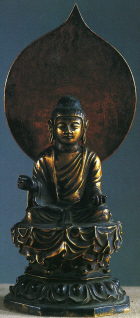
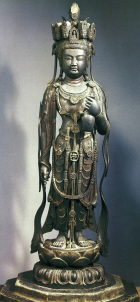
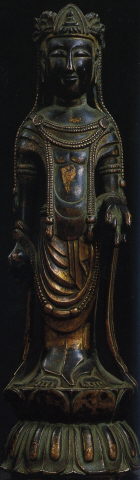
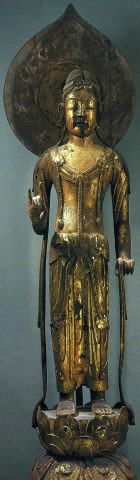
INTRO. Korea and China bring Buddhism to Japan during the Asuka Period, with the earliest sculptures and texts imported first from Korea then China. In subsequent decades, as the Japanese made their own sculptures, the resulting pieces looked almost identical to their Korean and Chinese counterparts. Extant statues from this period display a profound artistic influence from both nations, although the Korean influence is subsequently supplanted by the powerful artistic forces flowing out of China’s Tang dynasty (Jp. = Tō 唐; 618-907 AD). Small gilt-bronze statues (kondōzō 金銅像) were by far the most popular form of Buddhist art in early Japan. Hundreds are still extant.
|
|
BRONZE STATUES PHOTO TOUR
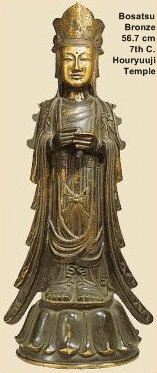
In the Asuka & Nara periods, gilt bronze statues (kondō 金銅) were imported in great number from Korea and China, and reproduced in Japan’s court-sponsored workshops. Bronze 青銅 and copper 銅 were the most popular sculpting materials (as well as dry lacquer 乾漆像 and clay 塑像 by the Nara era). Wood statues too were mostly imported or copied from Korean and Chinese models, but it wasn’t until the late 7th century that wood statues exceeded bronze sculptures in popularity. Below we present some of the most widely known bronze pieces:
|

SHAKA TRINITY
Famous Bronze Art of Japan’s Asuka Period
One of the most treasured and popular pieces of Japanese bronze
sculpture from this early period is the famous Shaka Trinity at
Hōryūji Temple 法隆寺 in Nara, one of Japan’s oldest temples.
 |
|
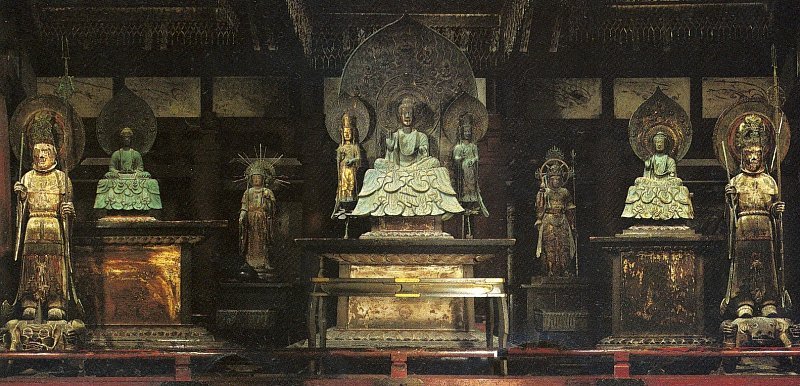
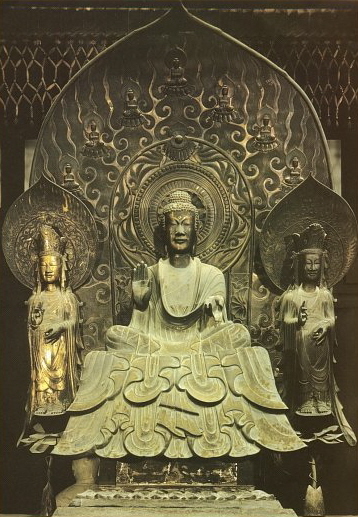
Shaka Triad (Shaka Sanzonzō 釈迦三尊像)
Treasure of Hōryūji Temple 法隆寺 (Nara), 632 AD
Historical Buddha (aka Shaka) surrounded by
attendants Monju Bosatsu and Fugen Bosatsu.
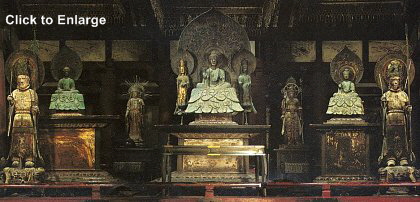
The altar at Hōryūji with Shaka Trinity in central position.
Legend says the central statue was made in the image of Prince Shōtoku Taishi. See below for more on this topic. Reportedly made by Kuratsukuri no Tori 鞍作止利, a Chinese (or perhaps Korean) emigrant who founded the Tori Busshi 止利仏師 school of early Buddhist sculpture in Japan.
Buddhist images of the Asuka Period were made primarily by artisans from Korea & China who lived in Japan. The period's mainstream works were the Tori-shiki 止利式 images of the Shaka Triad (shown above, by Kura-tukuri-no-Tori), the Asuka Daibutsu, the Guze Kannon, and many others. Tori-shiki sculpture was influenced by the Buddhist art of China’s Northern Wei 魏 kingdom (late 4th to 6th centuries). <This paragraph courtesy Asuka Historical Museum>
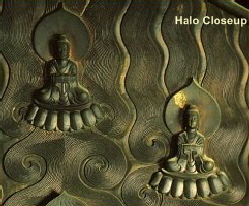  The halo is known as Ikkō Sanzon Kōhai 一光三尊光背, meaning “single-light triad halo,” because all three figures are enveloped inside one halo. The halo and its pointed top are also known as Funagata Kōhai 舟形光背 or “boat-shaped halo.” <source: JAANUS>. The halo is known as Ikkō Sanzon Kōhai 一光三尊光背, meaning “single-light triad halo,” because all three figures are enveloped inside one halo. The halo and its pointed top are also known as Funagata Kōhai 舟形光背 or “boat-shaped halo.” <source: JAANUS>.
There are seven figures on the halo, which reportedly represent the Seven Buddhas of the Past (Jp. = Kako Shichibutsu 過去七仏)
|
|
SHAKA TRIAD MYSTERY?
Below text by Henry Smith at Columbia University
From “Prince Shōtoku’s Temple, The Riddles of Hōryūji”
The inscription on the Shaka triad describes, in essence, a legend that the statue was created as a life-size replica of Prince Shōtoku Taishi himself (the founder of Hōryūji Temple, the great patron of Early Buddhism in Japan). The statue was made, it is said, at the time of his death, as a prayer for his ascent into the Pure Land. Mention is also made of the death about the same time of Prince Shōtoku’s mother and his principle wife, whom we can conclude are represented as the two attendants. So we have here Shōtoku deified as Shaka, an association already uncovered in the pagoda grotto. This special symbolism may be the key to unlocking many unsolved riddles about the iconography of this mysterious statue. The left-hand gesture of Shaka, for example, is found in no other Buddhist image. Equally baffling are the nut-like objects held in each hand by the attendants. <end quote>
Professor Smith also makes some very interesting remarks about the famous Guze Kannon (see below), also reportedly made in the image of Prince Shōtoku. Smith suggests that the spirit of the departed Shōtoku was an angry spirit, for Shōtoku’s son and heir was forced to commit suicide, thus ending Shōtoku’s direct line. This, claims Smith, is reflected in the construction of the Guze statue itself. See Guze Kannon below for details.
Says Bernard Faure
Professor, Religious Studies, Stanford University
In a piece entitled The Buddhist Icon and the Modern Gaze, Faure says: “Aesthetic considerations have steered us away, for instance, from exploring all the implications of the well-known (and often mentioned) fact that the Guze Kannon icon and the Sakyamuni Triad icon at Hōryūji were made the size of the ruler Shōtoku Taishi (+ 572-621). The Guze Kannon is even believed to be an image of Shōtoku Taishi, made while he was alive.”
BRONZE STATUES
Click any image for larger photo & textual details
Japan’s earliest sculpture was greatly influenced by the artistic nuances of China’s Wei 魏 kingdom (late 4th to 6th centuries), which featured a marked frontality, crescent-shaped lips turned upward, almond-shaped eyes, and symmetrically arranged folds in the robes. They were also influenced by the artistic styles of Korea’s Paekche 百済 and Silla kingdoms 新羅, especially the Korean preference for stock poses, most notably of Miroku Bosatsu.
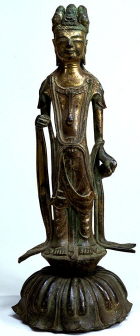
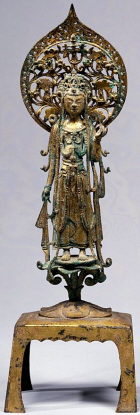
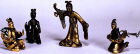
Hundreds of bronze pieces, mostly gilt bronze, are still extant. Many are small, around 30 cm in height, and coated with a thin layer of gold (tokin 鍍金) or gold leaf (hakuoshi 箔押). See Techniques Page for details on casting and gilding methods. Viewing many of them in one glance gives us a good idea of the artistic styles then prevailing among the first wave of Korean and Chinese imports into Japan in the 6th & 7th centuries. These pieces allow us to surmise how Japan developed its own distinctive style. One of the most famous groupings of extant gilt-bronze images, from China, is the Shijuhatai Butsu 四十八体仏, the so-called Forty-Eight Buddhist Images, now kept at the Tokyo National Museum. Of these, the most frequently occurring are images of Kannon Bodhisattva (22 are identifiable as Kannon).
|
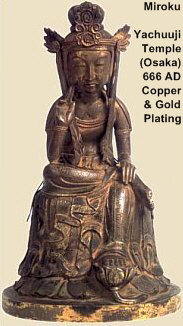
 Korean Influence & Miroku Bosatsu Korean Influence & Miroku Bosatsu
Prince Shōtoku Taishi, Japan’s first great patron of Buddhism, learned about Buddhism, it is said, mainly from two Korean monks. One hailed from the Korean Kingdom of Koguryo 高句麗 (Goguryeo), and was named Eji 慧慈 (えじ). The other hailed from the Korean Kingdom of Kudara 百済 (Paekche), and was named Esou 慧聡 (Esō えそう). Shōtoku also maintained strong relations with many immigrants from mainland Asia. Among these was Hatano Kawakatsu (秦河勝), the leader of the Hata 秦 clan, a group of immigrants from central Asia (as far west as Assyria) who traveled along the silk road, and finally made their way to Japan via Korea and China in the 4th century, bringing their Christian faith as well. (Editor’s Note: To people traveling east along the silk roads, Japan’s Naniwa and Nara areas were the eastern terminus. Conversely, for Japanese people traveling west, Naniwa or modern-day Osaka was considered the gateway to Korea, China, and greater Asia.) Hatano was, by many accounts, an important counselor to Prince Shōtoku. Shōtoku’s son, Yamashiro no Ōe no Ō 山背大兄王, took his name from the Yamashiro region in southern Kyoto where the Hata 秦 clan was established. This suggests that Shōtoku most likely maintained strong relations with this immigrant community. Prince Shōtoku was also apparently goods friends with Korean Prince Asa (kanji unknown), a contemporary of his (from what Korean Kingdom?).
 Korean Influence on Early Japan Korean Influence on Early Japan
Says JAANUS: Sangokubutsu 三国仏. Literally “three countries Buddha.” Buddhist statues made from the fourth to the seventh centuries in Korea. At that time, Korea was divided into three kingdoms; Koguryo (Goguryeo) 高句麗, Paekje (Paekche) 百済, and Silla 新羅. This period of Korean history is known in Japanese as the Sangoku Jidai 三国時代 (Three Countries Period), and Buddhist statues made during this period are known as Sangokubutsu 三国仏. The oldest of these kingdoms is Koguryo (Jp. = Kōkuri or Kōguryo), which developed in the third century in the northern part of the Korean peninsular. Buddhist culture was received and absorbed from China, and Buddhist statues were produced showing a very strong Chinese influence. The Paekje 百済 Kingdom (Jp. = Kudara) developed in the southwest part of the Korean peninsula around the mid-fourth century, and here too Buddhist statues were produced with a strong Chinese influence, received from the Chinese Fuyo culture. The Silla 新羅 Kingdom (Jp. = Shiragi), with its capital in Kyongju, the east-central part of Korea, also became important in the mid-fourth century. Its culture developed closely in line with northern China, and there was direct interchange with the Chinese Ryo 梁 and Chin 陳 cultures, as well as with Kanan province (South China). An example of Sangokubutsu, considered to be a masterpiece of ancient Silla culture, is the bronze hankazou 半跏像 image (half-cross-legged Miroku Buddha/Bosatsu) in the Tokujuguu 徳寿宮 Museum (Toksugung Museum), Seoul. <end quote from JAANUS>
Korean Influence on Temple Architecture in Early Japan. Shōtoku employed workers from Korea’s Paekche 百済 (Jp. = Kudara) Kingdom to build Hōryūji Temple (Houryuuji) 法隆寺, which today remains one of the world’s greatest extant treasure-houses of early Buddhist artwork and architecture in Japan. The temple in its heyday also housed people in adjacent areas where they studied the Buddhist teachings, art, and medicine. The original temple was destroyed, according to most records, in a fire in +670, although much of its artwork was somehow saved. It was rebuilt, according to most scholars, soon thereafter by artisans from Korea’s Paekche kingdom. Two other temples closely associated with Prince Shōtoku -- Hōrin-ji 法輪寺 or 法琳寺 and Hōkiji 法起寺 -- were most likely built by artisans of Korea’s Paekche kingdom.
Says JAANUS: Shiragibutsu 新羅仏 is a style of Buddhist sculpture made during the period of Korean history when the Silla Dynasty (Jp. = Shiragi 新羅) defeated the Koguryo (Goguryeo) 高句麗 and Paekje (Paekche) 百済 Kingdoms and united the Korean Peninsula. This period is known in Japanese as Shiragi Touitsu Jidai 新羅統一時代 (+654-935). The style of the sculpture was based on that of Tang Dynasty China (Jp; Tou 唐, +618-907), combined with characteristic Silla simplicity and gentleness. The statue said to best represent this style is the stone statue known in Japanese as Keishuu Sekkutsuan 慶州石窟庵, one of a number of shiragibutsu preserved in temples in Kyongju 慶州 (Jp; Keishuu), the capital of Korea’s Silla Dynasty. In addition to stone statues, shiragibutsu were also created in gilt bronze. Most are small figures (15-30 cm high) made in the late 8th and early 9th centuries, again using styles and techniques based on those of Tang China. <end quote from JAANUS>
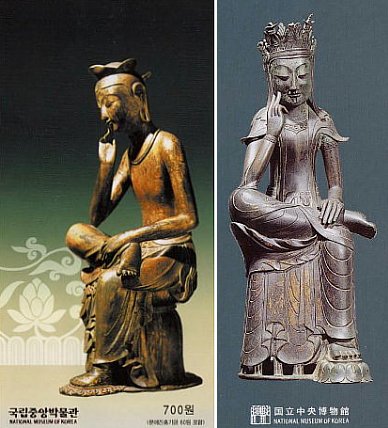
Miroku Buddha/Bosatsu in Korean Art
(L) Half-cross-legged Miroku 半跏像 徳寿宮
(R) Famous half-cross-legged bronze Miroku 半跏像 徳寿宮
Visit the National Museum of Korea
Click here for more on Miroku Bosatsu/Buddha
|
|
MIROKU BOSATSU / BUDDHA
Strong Korean Influence
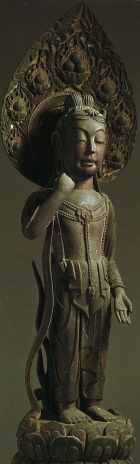
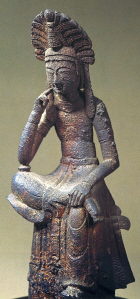
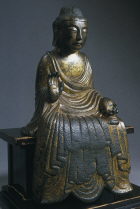
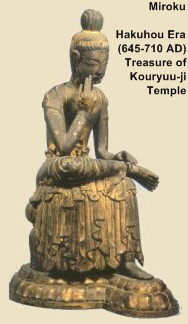
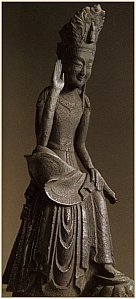
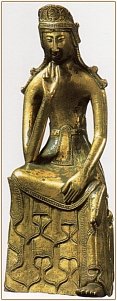
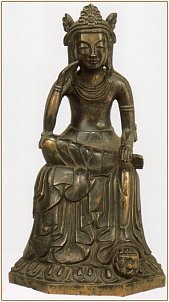
One of the most popular deities in the early years was Miroku Bosatsu/Nyorai. Hundreds of small gilt bronze statues of Miroku were imported into Japan from Korea (and also China) and then copied endlessly by Japanese artisans and court-sponsored workshops. The style of these statuettes was influenced primarily by Korean models. Below are some examples.
 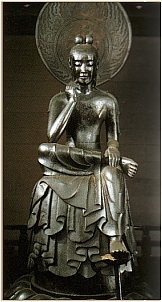
Miroku Bosatsu (Two views of same statue)
7th Century AD, Wood
Chuuguuji Temple 中宮寺 (Nara)
87 cm in height
|
Miroku Bosatsu 弥勒菩薩
Copper with Gold Plating.
Kudara Kingdom 百済, Korea
7th Century, 16.4 cm in height
Kanshō-in Temple 観松院, Nagano Pref.
Temple Web Site Here (Japanese Only)
|
Miroku Bosatsu 弥勒菩薩
Copper with gold plating.
Three Kingdoms Era, 6-7th Century AD
Houryuu-ji Temple, 20.4 cm in height
|
Miroku Bosatsu 弥勒菩薩
Copper with gold plating.
Three Kingdoms Era, 6- 7th Century AD
Houryuu-ji Temple, 23.6 cm in height
|
|
|
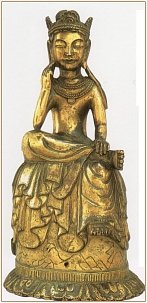
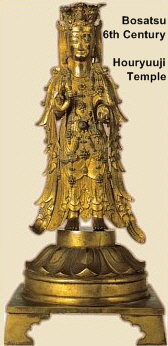
Miroku Bosatsu
7th Century AD
Houryuu-ji Temple
Copper with Gold Plating
H = 22 cm
|
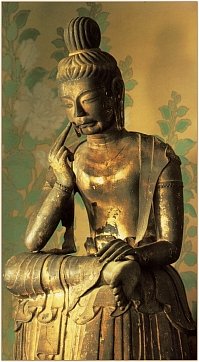
Miroku Bosatsu
Early 7th C. AD, Wood
Kouryuu-ji Temple
H = 66.4 cm
|
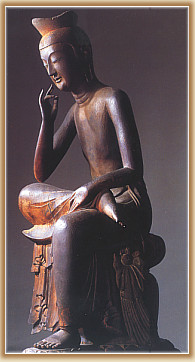
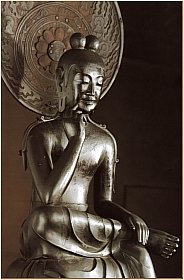
Miroku Bosatsu
7th Century, Kyoto, National Treasure
Koryuji Temple 広隆寺, Wood, H = 84.2 cm
Photo from book entitled Concise History of Japanese Buddhist Sculpture (page 015) Bijutsu Shuppan-Sha, ISBN 4-568-40061-9
|
|
|
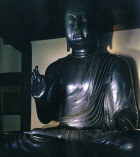
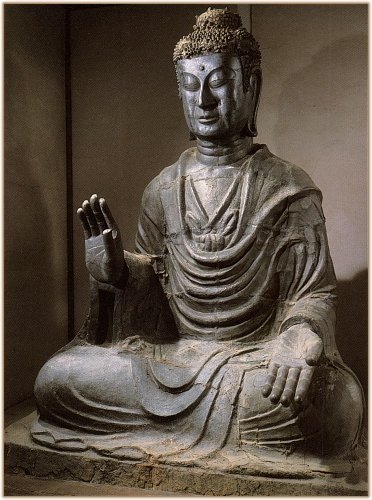
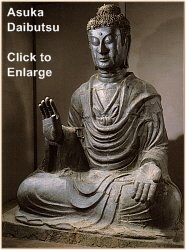 Asuka Daibutsu Asuka Daibutsu
One for the History Books
Constructed +609
Asuka Dera 飛鳥寺 is generally regarded as Japan's oldest temple. Located near Nara city in Japan’s Asuka district, the temple was built sometime around +588 and +596, and is also known as Gangōji 元興寺, Angoin 安居院, Hon-gangōji 本元興寺, and Hōkōji 法興寺. The temple was relocated when the capital moved to Heijōkyō 平城京 (today's Nara city). Its Nara-city counterpart is known as Gangōji 元興寺 (also spelled Gangouji, Gangoji), one of the Seven Great Temples of the Nara Period.
The temple in Asuka (not Nara) houses what is claimed to be Japan’s oldest Buddhist statue, the Asuka Daibutsu (Daibutsu literally means Big Buddha). Despite repairs and alterations, the statue's facial features and hands are still the originals. The Asuka Daibutsu, made of bronze, is said to be the work of Kuratsukuri no Tori 鞍作止利, a noted sculptor of those days whose ancestors came to Japan from China (others say Korea). The seated Asuka Daibutsu sculpture is 275.2 cm (2.75 meters) in height, and is designated an important cultural asset. More details about the statue are presented near the end of this section.
TEMPLE ACCESS & CONTACT INFO
- Asuka Dera TEL: 0744-54-2126
- Hours: 9:00 - 17:15 (or 9:00 - 16:45 from Oct. to March )
- Open 7 days a week
- ADDRESS: 682 Asuka, Asuka-mura, Takaichi-gun
Nara-ken, Japan
- For a fine review of the temple, please see Asukadera - A Battered Buddha by Ad G. Blankestijn (external link)
TEMPLE HISTORY, FAMOUS EARLY MONKS
The important Sanron School 三論宗 (literally Three Treatise School) of Buddhist philosopy was introduced to Japan around +625 by the Korean monk Hyegwan (Jp. = Ekan 慧灌, who hailed from the Korean kingdom of Kōkuri 高句麗 (often spelled as Koguryo or Goguryeo). Ekan resided at Gangōji Temple 元興寺 (aka Asuka Dera), a temple in the Asuka district that was built by the powerful Soga clan in the late 6th century. In the decades prior to his arrival, Asuka Dera had been the home of two other important Korean monks. One hailed from the Korean Kingdom of Koguryo 高句麗 (Goguryeo) and was named Eji 慧慈 (えじ). The other hailed from the Korean Kingdom of Kudara 百済 (Paekche) and was named Esou 慧聡 (Esō えそう). Both served as teachers and mentors to Prince Shōtoku Taishi. Many resources, both English and Japanese, say all three lived at Asuka Dera, but none say they lived together at the same time, or that they actually met each other. One source says Shōtoku gave this temple to Eji 慧慈.
MORE ABOUT ASUKA DAIBUTSU
Says the Asuka Historical Museum: “The Asuka Daibutsu was the main object of worship (honzon) in the Asuka Dera's original Chū-Kondō 中金堂 (central main hall). It was cast in +609 (the 17th year of Empress Suiko's reign) by the master Busshi 仏師 (literally Buddhist teacher, master, or sculptor) known as Kuratsukuri no Tori 鞍作止利 (aka Tori-busshi), son of a Korean immigrant. (Editor’s Note: Most sources say his grandfather immigrated from China, not Korea.) It is the oldest extant Buddhist image in Japan whose date of construction is definitely known. Repairs and alterations from later times are clearly in evidence, but in such features as the elongated face and the shape of the eyes may be seen the original characteristics of the Tori-shiki 止利式 (Tori style) of Buddhist imagery shared also by the Shaka Triad at the Hōryūji Temple. The granite base is original, as are the socketed stands (hozoana) presently placed on either side and serving to support the flanking attendant figures. Comparing the Asuka Daibutsu with the Horyu-ji Shaka triad, one is reminded of the power possessed by the Soga 蘇我 family, who were able to commission the building of a joroku-zo (see below note), or what was considered to be a full-scale image, one jo and six shaku (or about 4.8 meters) high, several times larger than the central figure of the Horyuji triad. Thus, if the sitting statue of the Asuka Daibutsu could stand up, the statue would be about five meters tall.”
NOTE: Jōroku (Joroku) 丈六
One Jō and Six Shaku (about 4.8 meters)
Jo-roku (or joroku) is equivalent to roughly 4.8 meters. Many “standing” sculptures in the early years of Japanese Buddhism are made to this specification. Jo is a unit of length, about three meters, and Roku means “six,” and this refers to six shaku (shaku is another Japanese unit of length, about 0.30 meters). Thus, Jo-roku is equivalent to roughly 4.8 meters. Actually, if the sitting statue of the Asuka Daibutsu could stand up, it would be taller than five meters.
WHO DOES ASUKA DAIBUTSU REPRESENT?
Some say Yakushi Buddha, others say Shaka Buddha
- Yakushi Nyorai, the Medicine & Healing Buddha. Says the Nara Prefecture Web Site: “Established in +596 by Soga-no-Umako 蘇我馬子 (an enthusiastic supporter of Buddhism in Japan), Asuka-dera 飛鳥寺 is mentioned in old reports as being three times as large as Hōryūji Temple. (Editor’s Note: The Asuka Historical Museum says the temple compound, during its heyday, was 200 meters on each side.) Such a gigantic temple reminds us of the powerful Soga 蘇我 clan of the times. The Asuka Daibutsu is an effigy of Yakushi Nyorai, a divine savior said to relieve people's present agony. It is the earliest large-sized Buddha statue in Japan, and is designated as an important cultural asset.”
- Shaka Nyorai, the Historical Buddha. Says the JAANUS Database: “The Asuka Daibutsu 飛鳥大仏 is a bronze statue 2 m 75 cm high, thought to represent Shaka Buddha 釈迦 (the Historical Buddha). It is the oldest surviving Buddhist statue in Japan today, estimated to have been completed in the year +609. Temple legend says that the sculptor was the famous Kuratsukuri no Tori 鞍作止利. The statue sits on a stone pedestal in the cross-legged posture known as kekkafuza 結跏趺坐 (outside link).”
 CONTROVERSY SURROUNDING CONTROVERSY SURROUNDING
ASUKA BIG BUDDHA STATUE
According to tradition, Buddhism was introduced to Japan in +538 (some say +552) when the king of Korea sent the Japanese court a small bronze Buddha statue, some Buddhist scriptures, and a message praising Buddhism (none of these early artifacts have survived). Most scholars believe it was the king of Kudara 百済 (aka Paekche, Paekje, Paikche, Baekje), a kingdom in Korea, who presented these gifts to the Japanese court then located in the Asuka region. Legend contents that the bronze statue was entrusted to the leader of the Soga 蘇我 clan, who acted as the chancellor of the young Japanese nation. But soon thereafter an outbreak of smallpox occurred, and clans opposed to Soga influence and Buddhism’s introduction claimed the statue was responsible for the sickness afflicting Japan. The emperor, hoping to diffuse the situation, ordered the statue thrown into the Naniwa River, near the court’s palace in current-day Osaka City. The statue was, according to legend, thereupon pitched into the river. The discarded statue, it is said, was later fished out of the river following the victory of the Soga clan, and is still, to this day, installed at Asuka Dera. This legend is incorrect, for the extant statue installed at Asuka Dera was cast in +609, and is much too large to be the legendary “first” Buddha statue to arrive in Japan. Perhaps the extant statue is a giant copy of that first small Buddha statue? This latter issue has never been resolved.
|
|
|
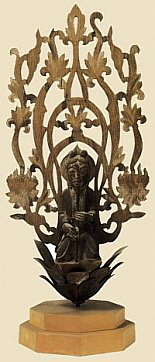
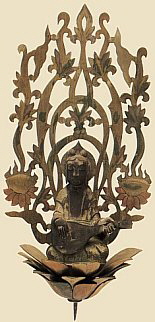
TENNIN (Apsaras)
Celestial Beings
Wood, H = 49.2 cm
7th C., Hōryūji Temple 法隆寺
|
WOOD SCULPTURE
OF THE ASUKA PERIOD
PHOTO TOUR
Below we present some of the most famous extant wood statues from this period.
Wood sculpture during Japan’s 6th and 7th centuries was made primarily of camphor (kusu 樟), carved from a single block of wood using the ichiboku-zukuri technique, and gilded or painted. However, wood sculptures were surpassed in quantity by the great number of bronze statues (kondou 金銅) that were made and imported during the period.
By the late 7th and 8th centuries, wood sculpture also competed with dry-lacquer statuary (kanshitsuzou 乾漆像) and clay figurines (sozou 塑像). See Techniques for more on these various art forms. In both the Asuka and Nara periods, the primary materials used in Buddhist statuary were bronze, earthenware, laquer, and wood. It wasn’t until the Heian Era that wood sculpture dominated the world of Japanese Buddhist statuary.
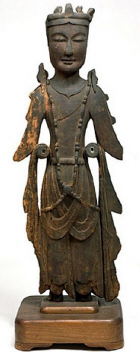
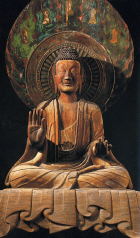
Japan’s earliest wooden sculptures were greatly influenced by the artistic nuances of China’s Wei 魏 kingdom (late 4th to 6th centuries), which featured a marked frontality, crescent-shaped lips turned upward, almond-shaped eyes, and symmetrically arranged folds in the robes.
They were also influenced by the artistic styles of Korea’s Paekche and Silla kingdoms. Buddhist images were made primarily by artisans of Korean or Chinese stock who lived in Japan. The period's mainstream works are credited to the Tori School, which originally hailed from Korea. Japan’s imperial court quickly set up guilds and workshops for painters, metal workers, wood carvers, and other artists.
|
|
|
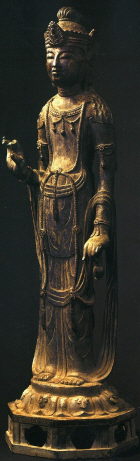
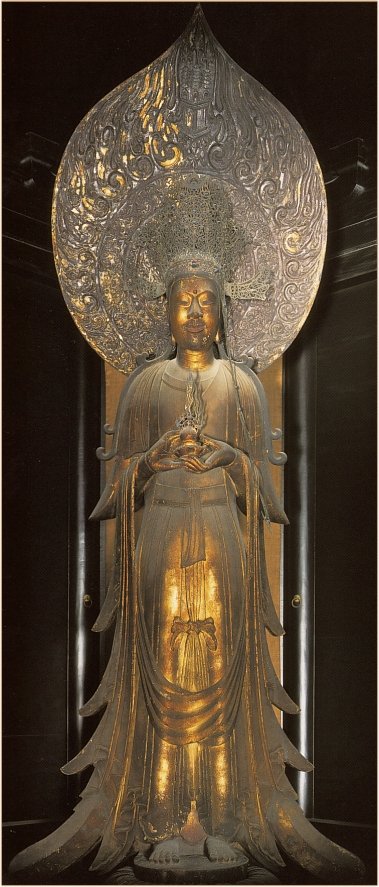
Guze Kannon (Guse, Kuze, Kuse) 救世観音、夢殿観音
Reportedly made in the image of Prince Shoutoku
Also called Yumedono Kannon
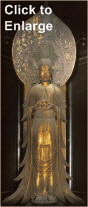 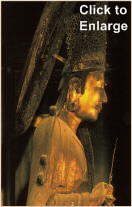 Hōryūji (Horuyji) Temple 法隆寺, Nara, 620 AD or so Hōryūji (Horuyji) Temple 法隆寺, Nara, 620 AD or so
7th Century, Height = 178.8 cm
Made from a single block of wood
= Camphor (Kusu 樟)
Gold leaf (hakuoshi 箔押) applied over surface,
and coronet and other details made from gilt bronze.
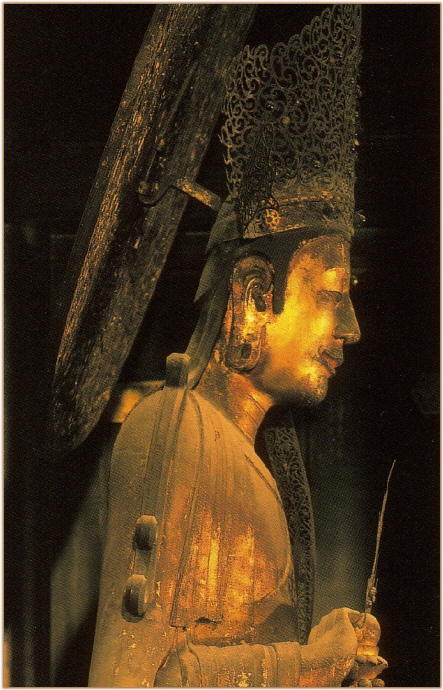
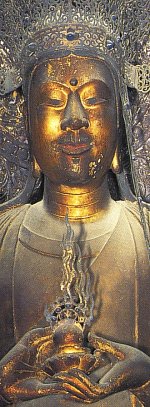 This is the earliest extant wooden statue in Japan (first half 7th century). Carved from one piece of camphor 樟 wood, in the style of those times. Gold leaf is applied over the surface, and the coronet and other details are made from gilt bronze. The effigy is the non-esoteric form of Kannon, as Esoteric Buddhism (Mikkyou 密教) did not arrive in Japan until the 9th century. Guze is also a name used for sculptures of the Asuka period, specifically for sculptures of a crowned Bodhisattva (Bosatsu) holding a jewel. This is the earliest extant wooden statue in Japan (first half 7th century). Carved from one piece of camphor 樟 wood, in the style of those times. Gold leaf is applied over the surface, and the coronet and other details are made from gilt bronze. The effigy is the non-esoteric form of Kannon, as Esoteric Buddhism (Mikkyou 密教) did not arrive in Japan until the 9th century. Guze is also a name used for sculptures of the Asuka period, specifically for sculptures of a crowned Bodhisattva (Bosatsu) holding a jewel.
This statue was kept hidden for centuries inside the Yumedono Hall 夢殿 at Houryuuji Temple -- even the priests were forbidden from viewing the statue, which was wrapped in some 500 yards of white cloth. The practice of maintaining Secret Buddha (Jp. = Hibutsu 秘仏) most likely originated among Japan’s esoteric sects (Shingon & Tendai) during the Heian period. The statue was finally unveiled in 1884, when the Japanese government allowed Ernest Fenollosa (1853-1908) and Okakura Tenshin 岡倉天心 (1863-1913) to discover its secrets. Fenollosa thought it to be of Korean origin, but no concensus was ever reached. Some think it displays the style of Japan’s Tori school of Buddhist sculptors who originally emmigrated to Japan from Korea. Today it is considered to be one of Japan's greatest art treasures for this period. It still remains a HIBUTSU at the temple, but for a small time every spring and fall it is open for viewing. <See JAANUS for more details on Guze Kannon>
GUZE KANNON MYSTERY?
Below text by Henry Smith at Columbia University
From “Prince Shōtoku’s Temple, The Riddles of Hōryūji”
Editor’s Note: A wonderful presentation, highly recommended.
Prince Shōtoku was, after all, like Shakyamuni (the Historical Buddha), a royal prince who renounced his inheritance in pursuit of spiritual ideals. Following Shōtoku’s death in + 622, his family continued to patronize Hōryūji Temple until 643, when his son and heir, Prince Yamashiro Ōe no Ō 山背大兄王 (Yamashiro Ōji 山背王子 for short), was forced to commit suicide by the Soga clan leader, who was fearful of the threat that Yamashiro posed to Soga power. With this, the direct line of Prince Shōtoku came to an end. The temple survivied, however, in close association with the memory of Shōtoku.
But as far as we can tell, the Yumedono Kannon was never seen by anyone from the time of its consecration in the eighth century until 1884, when an inquisitive American scholar named Ernest Fenollosa managed to unwrap it. Fenollosa survived the catastrophe predicted by the priests of Hōryūji, but even today, the Yumedono Kannon is on public view for only a few weeks every year.
YUMEDOMO KANNON (aka Guze Kannon). Centuries of oral tradition confirm what you have probably already suspected, that this image is in fact a representation of Prince Shōtoku, now transformed into a saving Kannon. This association probably explains some very curious features of the statue. To begin with, the hands are overly large, and reach sensuously around what you may recall from the rooftop ornament: another reliquary, in effect, Prince Shōtoku seems to be holding his own remains. The face is equally unique, featuring a wide nose, prominent lips, and very narrow eyes, all said to be personal attributes of the prince himself.
But there is a very different school of thought which sees the smile as oriented outward, a sinister leer which threatens more than it saves, particularly when seen from below as the normal worshipper might. This has led to the eerie interpretation that the Yumedono Kannon is not a gentle and grace-giving Kannon, but rather the restless angry ghost of Prince Shōtoku himself. In support of such a theory consider a comparison between the Yumedono Kannon and the famous Kudara Kannon statue (also found at Hōryūji). The point of the comparison lies in the haloes. Whereas the halo of the Kudara Kannon is supported by a slender bamboo pole, that of the Yumedono Kannon is attached by a large nail driven into the back of the head. This highly unusual method of attachment, it is argued, is just like the voodoo technique of sticking pins in dolls, an effort to subdue the spirit of Prince Shōtoku rather than save it. This might also help explain why the image was kept wrapped up for so many centuries. The remaining mystery, however, is why the revered Prince Shōtoku should be so angry. The most persuasive theory is that his ghost was angered by the termination of his family line in + 643, when his son was forced to suicide by the Soga clan leader. <end quote from Henry Smith at Columbia University>
Shotoku did dispatch envoys in 607 CE, all of them being of Korean descent who could read Chinese; the boat coasted the Korean shoreline as a direct passage was too dangerous. Ancient records report that the Chief Envoy (a Korean) asked the Chinese emperor to address Japan as "Land of the Sun" instead of "Land of Dwarfs," but this was not done until 670 CE (again at the suggestion of a Korean who felt the term insulted Japan). Nothing much with regard to the exchange of gifts from these early voyages is recorded in the Nihongi.(Carver and Covell 63)
In 621 CE Prince Shotoku died in his sleep. As was the custom, Hye-che ordered a gilt bronze statue to be made "in the image of Prince Shotoku." This statue became known as the "Dream Hall Kuanyin" or Yumedono Kannon. Probably this statue was placed in "The Dream Hall" of the first Horyu-ji. It was rescued by monks during the fire of 670 CE. For centuries this statue was considered "sacred" and was worshipped in a closed black lacquer case without being opened or unwrapped. In modern times, this statue is seen only once a year.
When the statue was first unwrapped after many centuries, Ernest Fenollosa, an American enthusiast of Japan's traditional arts, particularly Buddhist pieces, remarked "Korean of course." Apparently Fenollosa felt that the statue was not "Japanese" and not "Chinese," and knowing the great influence of Korea on the Asuka-based kingdom, reached the only reasonable conclusion.
The "Dream Hall Kuanyin" is a little short of six feet. (Supposedly Shotoku was this tall, a descendent of 'Horseriders' from the north. These people were taller than ordinary Japanese at this time (5'3"). The gold leaf is in very good condition due to the fact that it was covered all those years. The statue has a two dimensional quality, has 'fins' or sawtooth-cutouts along the outer edges of the robe, a technique or mannerism begun by Wei-dynasty bronze casters. It possesses the most intricate bronze crown of any statue in Asia. It appears to be a mixture of several styles (all Korean) and designs; no known parallel exists with purely Japanese workmanship. Evidently it was shaped and cut out by a master craftsman, someone having a long tradition of metal technology behind him. The basic design was drawn from the tradition of the Horseriders, as evidenced by their objects in iron, bronze and gilt-bronze. Koguryo tomb painting also has similar designs, such as the "climbing flame," and the eagle with outstretched wings, plus a slightly modified honeysuckle pattern. The crown bears jewels of several types, the most noticeable being the lapis-like blue globes. These outline the figure of a human being in their placement. At the pinnacle of the crown stand onion-dome type cutouts, pieces which take the shape of the sacred fire of Buddhism. (This motif is shared by both Koguryo and Paekche.) The Dream Hall Kuanyin originally had pendants hanging from each side like the crowns unearthed in Kyongju tombs. The one on the left side of the head is preserved, but the other is missing. The face shows a softness of the brow ridge. It merges as naturally as possible into the forehead, as those of a lifelike person. The Korean eye and brow ridge together were to continue through Unified Silla even though the chubby-cheeked Buddhas of this period show Tang Chinese influence.(Carver and Covell 68)
|
|
|
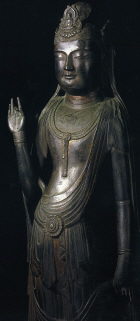
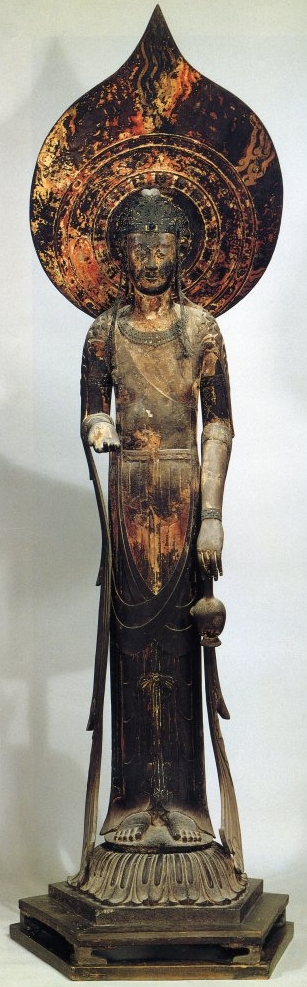
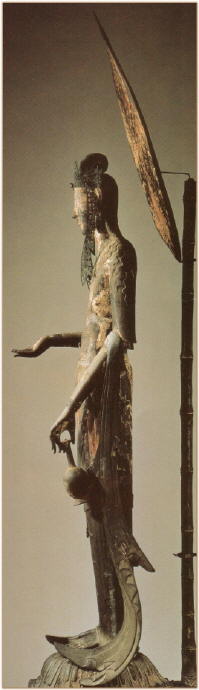
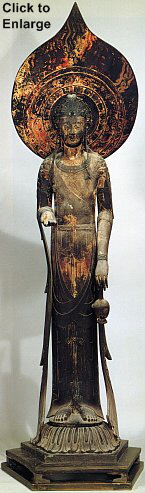 Kudara Kannon Kudara Kannon
7th Century
百済観音
Click any image to enlarge.
Hōryūji (Horuyji) Temple 法隆寺, Nara
Wood (Gilded Camphor 樟)
with Polychromy, H = 210 cm
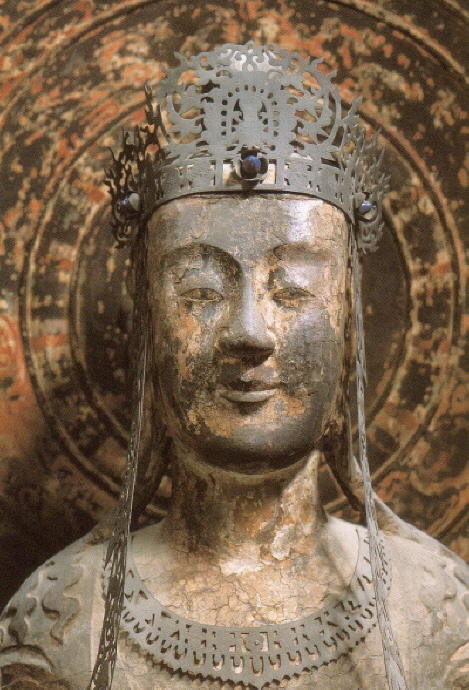
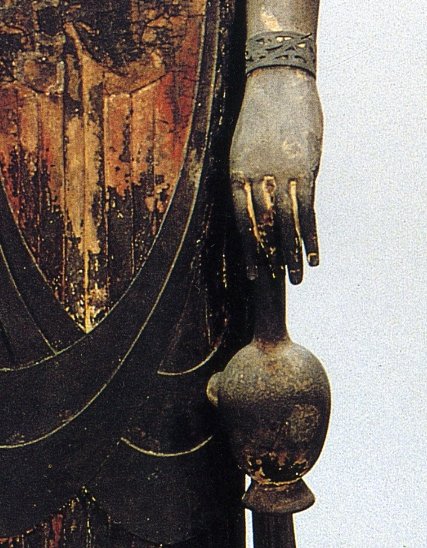
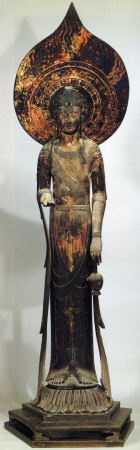
Most scholars believe this statue came from Korea or was made by Korean artisans living in Japan. The name of the statue -- Kudara Kannon 百済観音 -- literally means "Paekche Kannon." Paekche (Paekje 百済) was one of three kingdoms in Korea during this period, and Kannon is one of the most beloved Buddhist deities in Asia. The statue’s extreme thinness seems at first bizarre, but the serenity in the face and the beautiful openwork bronze in the crown are marvelous. The vase symbolizes the “nectar” of Kannon’s compassion -- it pacifies the thirst of those who pray to Kannon for assistance.
There are many indications that the statue came from Korea (or was made by Korean artisans in Japan). The superior workmanship of the piece, plus many of the stylistic nuances (faint smile, slender face, thin body, folds in garment, halo) are all hallmarks of Paekche artisans and generally conform to artwork from Korea’s Three Kingdom Period. In the book Korean Impact On Japanese Culture (Korea: Hollym International Corp., 1984), authors Jon Carter Covell and Alan Covell say the foremost clue of Paekche influence is the crown's honeysuckle-lotus pattern, which can also be found among the artifacts discovered in the tomb of Paekche's King Munyong (reigned +501-523). The coiling of the vines, they say, plus the number of protrusions from the crown petals, are nearly identical to similar extant Korean pieces.
|
|
|
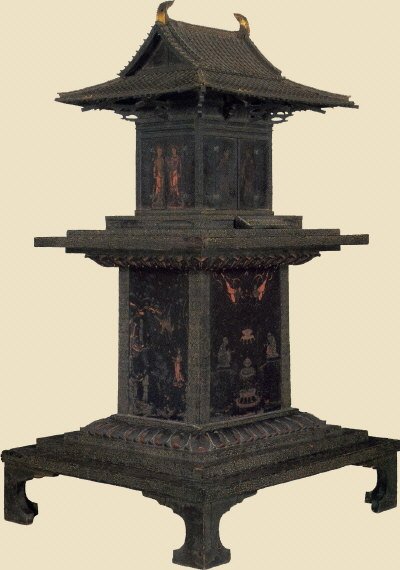
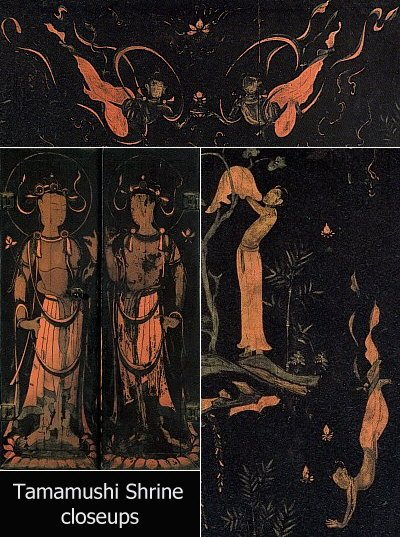
Tamamushi Shrine 玉虫厨子
7th Century, Wood, Hōryūji (Horuyji) Temple 法隆寺, Nara
Korean art presented to Japan, H = 226.6 cm W = 136.7 cm
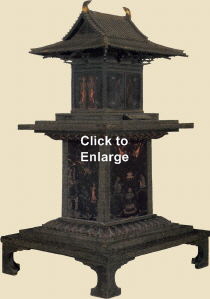 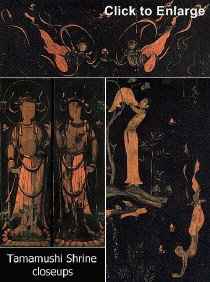
Says Ernest F. Fenollosa in “Epochs of Chinese & Japanese Art:”
Another great monument of 6th (or 7th century) Korean art is the Tamamushi Shrine, a miniature two-story temple made of wood, to be used as a reliquary, which was presented to the Japanese Empress Suiko about 597 AD, and which still stands in perfect preservation upon the great altar at Houryuuji Temple 法隆寺 (Nara). The roof is finished in metal in the form of tiling. Lower story has painting on all four sides. Upper story opens with miniature temple doors, and is elaborately painted on the exterior. Long lanky Buddhist angels fly through the air. The finest paintings, and the best preserved, are the two tall thin Buddhist deities upon the doors, which show a relationship to the thin art of the Northern Wei. But the most striking feature about the shrine is the elaborate finish of all the corners and pillars and transverse beams with an overlay of plates of perforated bronze, which were probably gilded, the patterns of the perforation being among the finest specimens of the Korean power over abstract curvature.
NOTE: Today, Japan’s scholars date this piece to sometime in the 7th century (to Japan’s Nara Period). Zushi 厨子 is the Japanese word for a miniature shrine, wherein are kept Buddhist images or sutras 経.
|
|
MORE WOOD STATUES
The first three (two already appeared above) are shown here to give the viewer a good idea
of the Chinese & Korean models that influenced the early creation of Buddhist sculpture in Japan.
Click any photo to begin. Each is accompanied by deity name, material, size, and location.
|
Asuka Period Historical Notes, Political Setting
|
|
|
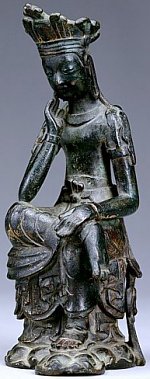
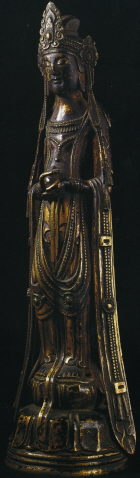
Bodhisattva
H = 16.3cm, Gilt Bronze,
7th C., Korea
Three Kingdoms Period
At Tokyo Nat’l Museum
|
|
The capital in those days was located in the Asuka district of the Yamato 大和 region (modern Nara prefecture), hence the era name. The early years are also referred to as the Suiko Period 推古時代, in reference to Empress Suiko 推古 who reigned from 592 to 628 AD. Her nephew was Prince Shoutoku, who is widely credited as the foremost patron of Buddhism in Early Japan.
It was a period when professional artisans from Korea and China traveled to Japan in great numbers to teach the arts of carving and sculpture (and to escape political turmoil in their own lands, especially for Korean immigrants from the Kingdom of Kudara). These and other emissaries brought the Chinese written and spoken language, which remained the de facto language of the young Japanese nation until the 9th century. The introduction of the Chinese writing system in Japan, moreover, helped spread literacy, and resulted in the first great compilations of Japanese history, including the Kojiki 古事記 (Record of Ancient Matters) and Nihonshoki 日本書紀 (Chronicles of Japan). The Kojiki and Nihonshoki are considered by most scholars to be Japan’s oldest surviving histories. Although compiled in the late Asuka period, they were not disseminated until the early years of the subsequent Nara era.
The late Asuka period is commonly referred to as the Hakuhou Period 白鳳時代 (646 to 710 AD), highlighted by the relocation of the capital to Naniwa 浪速 (in modern Osaka) and sweeping governmental changes following the Taika Reforms (Taika-no-Kaishin 大化改新) of 645 to 646 AD -- a turbulent time when the imperial court staged a coup to regain supremacy from the usurping Soga 蘇我 clan. These reforms abolished private ownership of land, distributed land more equally among farmers, appointed new governors in the provinces, and replaced the old tax structure with a new imperial tax system. The reforms were based largely on similar successful policies in Tang-dynasty China.
The entire period (from 538 to 710 AD) was marked by strong court patronage of Buddhism, the rapid construction of temples (which increased tenfold in the Hakuhou period), the arrival of countless artisans, priests, and scholars from Korea and China, the creation and copying of numerous works of Buddhist art, and numerous Japanese missions (outside link) dispatched to China. Buddhism brought new theories on government, a means to establish strong centralized authority, a system for writing, advanced new methods for building and for casting in bronze, and new techniques and materials for painting. Buddhism was, in most respects, adopted by Japan's rulers primarily to establish social order and political control, and to join the larger and more sophisticated cultural sphere of mainland Asia. Despite early resistance to the imported Buddhist faith, Buddhism made strong headway among the court and upper classes, but had minimal impact on the common people.
Japanese art until the 9th century is primarily "religious" art, confined to temple construction, Buddhist sculpture, painting, illustrated hand scrolls to transmit Buddhist teachings, and mandalas of the Buddhist cosmos and its deities. I have yet to study the Asuka Period in depth, but it is clear that guilds of professional Japanese craftsmen (those who carved the statues) began to emerge soon after Buddhism’s transmission to Japan.
The most important surviving temples from the Asuka period are Houryuuji (Horyu-ji) Temple 法隆寺 (Nara), Shitenno-ji Temple 四天王寺 (Osaka), and Yakushiji Temple 薬師寺 (Nara). All are modern-day treasure houses of Japan’s earliest Buddhist artwork.
NOTE: Japan's break with China in the late 9th century provides an opportunity for a truly native Japanese culture to flower, and from this point forward indigenous secular art becomes increasingly important. Religious and secular art flourish in step until the 16th century, but then the importance of institutionalized Buddhism plummets owing to the Confucian ethic of the Edo-period shogunate, contact with the Western world, and political turmoil. Secular art becomes the primary vehicle for expressing Japanese aesthetics, but it is tempered greatly by the "spontaneity" of Zen Buddhism and the "affinity to nature" of Shinto. Nonetheless, generally and overall, Buddhist sculpture slips into decline after the Kamakura era. |
|
LEARN MORE (Notes & Reference Materials)
- Chinese and Korean Influence
Abridged from writings of Louis Frederic
Flammarion Iconographic Guides ISBN 2-08013-558-9
The earliest sculpted images appearing in China were copied from imported models (probably from Gandhara, India) in the first century. These images, until the 4th or 5th century, were typically carved into solid rock, on the walls of caves and holy places. Most images were carved in high relief, to be viewed from the front. Images from China's WEI period portrayed the Buddhist deities with wide forheads, sharp bridged noses, small mouths, slim bodies, and facial attitudes both stiff and majestic. This so-called WEI style was a major influence on the early sculptural traditions of both Korea and Japan. Clay was the preferred material in China until the sixth century, but the Chinese also produced numerous bronze pieces in the same style. By the Tang period, however, Chinese Buddhist statuary had distanced itself somewhat from the styles of India, and began to portray the Buddhist divinities with greater realism, supple attitudes, fuller forms, clothed in flowing garments, and decked in ornaments (bracelets, jewels, etc.) The decorative art of the caves continued to predominant, and smaller statuary made from bronze, wood, or stone became less frequent. By the late 9th century, the art of sculpture fell into decline, overshadowed by a preference for paintings. After the persecutions of 845 AD, Buddhist sculptural art in China fell into decadence, with the same early copies ceaselessly reproduced, often with midiocre results. The early sculptural style of Korea adhered closely to the Chinese models, but the Koreans were more enamored by the divinities from the estoric schools, and the images they produced strongly influenced the Japanese tradition.
- Bronze Statues & The Famous Shijuhatai Butsu
Forty-Eight (48) Buddhist Images 四十八体仏
Below text courtesy Asuka Historical Museum
One of an assemblage of 59 miniature gilt-bronze Buddhist sculptures 小金銅仏, produced at various times from the Asuka 飛鳥 through the Tempyo 天平 (Nara) Periods. They were at one time in the possession of Horyuji Temple 法隆寺. Among them are several which had been transferred there from the Tachibanadera 橘寺 in the 11th century. They are presently housed in the Tokyo National Museum 東京国立博物館. The number "forty-eight," while inaccurate as a name for the present collection, seems to have been chosen as a reflection of the 48 Vows of Amida 阿弥陀の48願. <end quote Asuka Museum>
Says the British Museum: The extant images in fact number fifty-three, and are now in the keeping of the Tokyo National Museum. In the 12th century, the total appears to have been 112. After 672 AD, as the China-oriented polices of Emperor Temmu began to influence Japanese Buddhism away from its Korean founders and towards direct contacts with China, images of Kannon were among those most frequently imported from China and imitated from Chinese models. This is borne out by the large proportion of such images included in the Forty-eight Bodhissatvas which were preserved by the Houryuuji Temple. Twenty-two images identifiable as Kannon are included in this famous group. <See "Acquisitions of Works of Art by Museums and Galleries: Supplement" in The Burlington Magazine, Vol. 107, No. 745. Story is titled "The Art of the Past, British Museum, A Nine-Faced Bronze Kannon.">
-
|
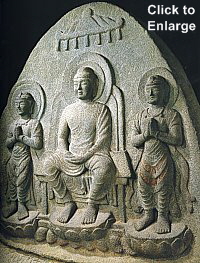
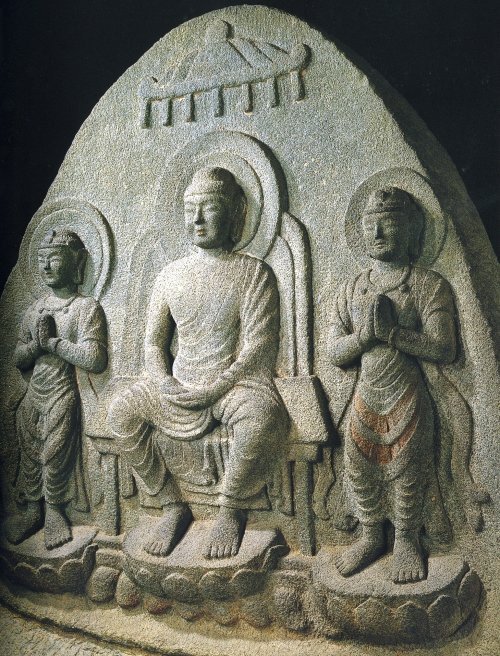
Stone
Buddha Triad
Sansonzou 三尊像
H = 115.4 cm
Ishiidera 石位寺 (Nara)
Late 7th Century
Photo by Ogawa-Kōzō
|
|
Stone Sculpture.
Painting guild or official bureaux is established, and includes Chinese artists among their members. Bronze and clay are main materials, not much wood sculpture. The oldest known sekibutsu 石仏 (stone sculpture) in Japan is the Buddha Triad (Sansonzou 三尊像) at Ishiidera 石位寺 Temple (Nara ; late 7th century). The main deity and two attendants were carved from a single chunk of stone in intermediate elief (hannikubori 半肉彫). Another well-known example is the 8th century bodhisattva group called Zutou 頭塔 (Nara), which depicts 13 figures carved in low relief (usunikubori 薄肉彫)on one stone block. For more on Sekibutsu, click here.
- Rock Carvings. Rock carving flourished in the Han, and Northern and Southern dynasties in China (1th to 6th centuries AD) as well as in India, Afghanistan, and Korea. In Japan, magaibutsu never formed the mainstream of Buddhist sculpture, but there are many surviving examples dating from the 7th to 14th century AD. Stone was the chief material used for Buddhist images in China and India, whilst in Japan stone statues have never challenged the dominance of wood and bronze because appropriate stone materials were not so readily available. See JAANUS for more on sekibutsu.
- Murals. Murals at Houryuuji. The Korean monk Tamjing (Doncho in Japanese) from Goguryeo is credited as the painter of the famous murals on the walls of the Kondo. <see Wikipedia>
- ASUKA HISTORY. Nakatomi Kamatari (614-69), who founded the Fujiwara clan, assisted the takeover and devised the great reforms. The Four Articles of the Great Reform of 646 increased imperial control by abolishing private ownership of land, appointing provincial and district governors, registering people in order to distribute land to cultivators equally, and replacing old taxes and forced labor with an imperial tax system. Though modified by Japanese customs, these reforms were based on successful Tang dynasty practices of the Chinese. Large landowners were made provincial governors, while landed gentry became district supervisors appointing secretaries, accountants, and tax collectors; but weapons were collected and put in government storehouses. <Need to Quote Source; not my writing>
PHOTO CREDITS, WEB RESOURCES
|
|

Exploring the Beauty of Japan #11
July 9th, 2002
40+ pages, 70+ color photos
Japanese Language Only
Publisher: 小学館、東京都千代田区
一ツ橋 2-3-1, TEL: 03-3230-5118
Wonderful magazine featuring treasures of Hōryūji (Horuyji) Temple 法隆寺 in Nara. Some photos appearing above were scanned from this magazine.
|
|
- JAPANESE EMBASSIES TO CHINA
http://darumapilgrim.blogspot.com/2005/12/kentooshi.html
http://academic.hws.edu/chinese/huang/mdln210/pilgrims.htm
- History of Soga Clan, by Sanderson Beck
http://www.san.beck.org/3-11-Japanto1615.html
- READING LIST: KOREAN INFLUENCE IN JAPAN
Below list courtesy K12 Class Syllabus of Marymount School:
- Catalogue: Kyongju and the Silk Road. Korea: Kyongju National Museum, 1991.
- Catalogue: A Search for the Light of the East - Silk Road and Korean Culture. Korea: Kyongju World Expo., 2000.
- Catalogue: Gyeongju National Museum.
- Covell, Jon Carter and Covell, Alan. Korean Impact On Japanese Culture. Korea: Hollym International Corp., 1984.
- Kim. Young-Joo. Kyongju, Old Capital of Shilla Dynasty Enlivened with 2000-year History. Seoul: Woo Jin Publishing Co., 2000.
- Portal, Jane. Korea Art and Archaeology. New York: Thames and Hudson, Inc., 2000.
- Yi, Kun Moo. National Museum of Korea. Seoul: National Museum of Korea, 1998.
- Lucky Seventh: Early Horyu-ji and Its Time by J. Edward Kidder, Jr.
First Published July 2007
Note on Korean influence. Large numbers of Koreans fled to Japan in the 6th and 7th centuries to escape incessant warring among the three Korean kingdoms of Silla (Jp. = Shiragi 新羅), Paekje / Paekche (Jp. = Kudara 百済) and Koguryo / Goguryeo (Jp. = Kōkuri 高句麗). These immigrants brought numerous Buddhist images and texts, and played major roles as Buddhist academics, teachers, sculptors, artisans, and architects. Many of Japan’s earliest temple structures were made by Korean craftsmen, for example. For more on the Korean influence, click here.
|
|