|
|
|
|
Last Update: July 2014, Added photo; also added note on constellations
ZODIAC CALENDAR & LORE
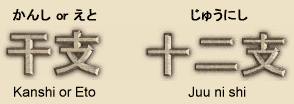
Kanshi (or Eto) 干支 = Zodiac Calendar
Jūnishi (Junishi) 十二支 = 12 Zodiac Animals
Origin = China
|
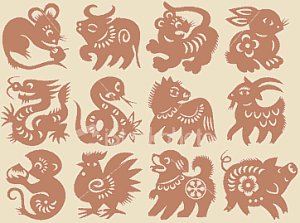
Twelve Animals of the Chinese Zodiac System.
Known in Japan as Jikkan Jūnishi 十干十二支,
lit. “10 Stems and 12 Branches.” It refers to the
Chinese Zodiac’s 10 stems, 12 animals, and
sexagenary (60-year) cycle. Details below.
Above photo shows modern
Chinese paper-cuts (Jp. = Senshi 剪紙).
Photo Courtesy this J-Site.
|
|
 The Chinese Zodiac is part of an elaborate and laborious system based on Chinese astrology, cosmology, and divination. It was calibrated to track the waxing and waning phases of the moon, used as a method for counting years, months, days and hours in the Chinese imperial court and civil calendar, and utilized to forecast one’s future and determine one’s character. Although replaced in modern times by the Gregorian (solar) calendar, the Zodiac is still used today (unofficially) as a popular method of divination in many Asian and Western nations. The Chinese Zodiac is part of an elaborate and laborious system based on Chinese astrology, cosmology, and divination. It was calibrated to track the waxing and waning phases of the moon, used as a method for counting years, months, days and hours in the Chinese imperial court and civil calendar, and utilized to forecast one’s future and determine one’s character. Although replaced in modern times by the Gregorian (solar) calendar, the Zodiac is still used today (unofficially) as a popular method of divination in many Asian and Western nations.
The Chinese Zodiac is the preeminent calendar of old-world Asia. Its 60-year (sexagenary) cycle is still of crucial importance to modern art historians, for it helps them pinpoint the date of artwork made in earlier times. Although the Chinese Zodiac is based on a 60-year cycle, most folks only know about the 12-year cycle associated with 12 Zodiac animals.
The Chinese Zodiac differs in many crucial respects from the Western Zodiac, and the two should not be confused. The former is based on a lunar year and five 12-year sub-cycles, while the latter revolves around a 12-month solar year. The Chinese zodiac, moreover, is not equated with constellations, as is the occidental zodiac. However, Chinese astrology does in fact incorporate numerous concepts from the Hellenistic zodiac and from Indo-Iranian astrology, including the Nine Luminaries & the 28 Lunar Mansions.
Most scholars believe the Chinese Zodiac originated well before the Historical Buddha’s birth in India (who was born around 500 BC). In China, the earliest depictions of the 12 Zodiac animals appear in tomb-ceiling paintings dated to 533 BC <source: NY Metropolitan Museum of Art>. China’s Zodiac system grew more elaborate and complex over the centuries, but its importance in China ensured its acceptance elsewhere, and thus it greatly influenced and colored the subsequent development of Buddhist traditions throughout Asia. In China, where Buddhism was introduced in the 1st & 2nd centuries AD, the 12 Zodiac animals became associated with Buddhism’s 12 Heavenly Generals as early as the Sui Dynasty (581-618).
When Buddhism arrived in Japan in the mid-6th century AD, the Japanese eagerly imported both the Buddhist teachings and the Zodiac calendar -- the calendar was officially adopted in 604 AD. In Japan, the Zodiac calendar is known as Kanshi 干支 (also read Eto), and the 12 animals of the Zodiac are known as the Jūni Shi (Juni Shi) 十二支. The Zodiac’s popularity in Japan peaked during the Edo Era (1600-1868 AD), by which time each of the 12 animals were commonly associated with one of eight Buddhist patron protector deities (four guarding the four cardinal directions and four guarding the four semi-directions; the latter four are each associated with two animals, thus covering all 12 animals). At many Japanese temples even today, visitors can purchase small protective amulets or carvings of their patron Buddhist-Zodiac deity. In Japan, the lunar calendar was abandoned in 1872 in favor of the solar (Gregorian) calendar, but even today many temples and shrines continue to use the lunar calendar for important festivals and events. For details, see Zodiac Lunar Trivia in Japan below.
|
|
|
|
|
|
|
|
|
|
SIMPLIFIED ZODIAC CHART (Solar Calendar)
|
|
Zodiac
Animal
|
Buddhist
Patron
|
Compass
Direction
|
Year of Birth
For people born in Jan. or Feb., see Caveat
|
|
Rat 子
|
Senju Kannon
|
N
|
1924, 1936, 1948, 1960, 1972, 1984, 1996, 2008
|
|
Ox 丑
|
Kokūzō Bosatsu
|
NE
|
1925, 1937, 1949, 1961, 1973, 1985, 1997, 2009
|
|
Tiger 寅
|
Kokūzō Bosatsu
|
NE
|
1926, 1938, 1950, 1962, 1974, 1986, 1998, 2010
|
|
Hare 卯
|
Monju Bosatsu
|
E
|
1927, 1939, 1951, 1963, 1975, 1987, 1999, 2011
|
|
Dragon 辰
|
Fugen Bosatsu
|
SE
|
1928, 1940, 1952, 1964, 1976, 1988, 2000, 2012
|
|
Snake 巳
|
Fugen Bosatsu
|
SE
|
1929, 1941, 1953, 1965, 1977, 1989, 2001, 2013
|
|
Horse 午
|
Seishi Bosatsu
|
S
|
1930, 1942, 1954, 1966, 1978, 1990, 2002, 2014
|
|
Sheep 未
|
Dainichi Nyorai
|
SW
|
1931, 1943, 1955, 1967, 1979, 1991, 2003, 2015
|
|
Monkey 申
|
Dainichi Nyorai
|
SW
|
1932, 1944, 1956, 1968, 1980, 1992, 2004, 2016
|
|
Rooster 酉
|
Fudō Myō-ō
|
W
|
1933, 1945, 1957, 1969, 1981, 1993, 2005, 2017
|
|
Dog 戌
|
Amida Nyorai
|
NW
|
1934, 1946, 1958, 1970, 1982, 1994, 2006, 2018
|
|
Boar 亥
|
Amida Nyorai
|
NW
|
1935, 1947, 1959, 1971, 1983, 1995, 2007, 2019
|
|
 CAVEAT: There is approximately a one-month disparity between the lunar and solar calendars, so one’s Zodiac sign may differ from that shown above for people born in January or February. For example, say you were born on 19 Jan. 1987. Your sign is not the HARE (as shown above), but rather the TIGER. Why? Because the lunar year back then began on 9 Feb. 1986 and ended on 29 Jan. 1987. People born on Jan. 30 (1987) or thereafter are HARE folk, but people born between Jan. 1 and Jan. 29 (1987) are TIGERS. To determine your exact animal sign and Buddhist patron based on the Chinese lunar calendar, see below lunar chart. Alternatively please click here. To learn more about the lunar vs. solar calendar, click here. CAVEAT: There is approximately a one-month disparity between the lunar and solar calendars, so one’s Zodiac sign may differ from that shown above for people born in January or February. For example, say you were born on 19 Jan. 1987. Your sign is not the HARE (as shown above), but rather the TIGER. Why? Because the lunar year back then began on 9 Feb. 1986 and ended on 29 Jan. 1987. People born on Jan. 30 (1987) or thereafter are HARE folk, but people born between Jan. 1 and Jan. 29 (1987) are TIGERS. To determine your exact animal sign and Buddhist patron based on the Chinese lunar calendar, see below lunar chart. Alternatively please click here. To learn more about the lunar vs. solar calendar, click here.
|
|
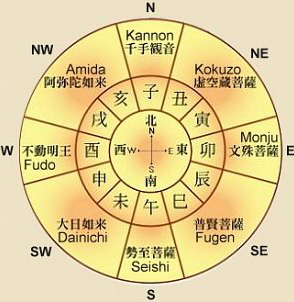
Eight Buddhist Patron Deities
and the 12 Zodiac Animals
|
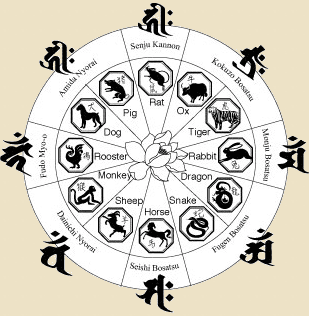
8 Buddhist Patrons, 12 Zodiac Signs, & Sanskrit Seeds
Courtesy Horie Yasutaka (Modern Buddhist Artist)
|
|
NOTE: In addition to the Eight Buddhist Deities and 12 Zodiac Animals shown above, there are Zodiac traditions involving other popular Japanese deities. In the list below, we show the Ennichi 縁日 (literally "related day" or "day of connection" and translated as “holy day”) for other deities. Ennichi are thus days with special significance to one particular deity. Saying prayers to this deity on this day is believed to bring greater merits and results than on regular days.
The situation is actually much more complicated. For example, a very auspicious day is the day of the snake in the month of the snake in the year of the snake. Indeed, the founder of the Kamakura Shōgunate -- Minamoto Yoritomo 源頼朝 (1147-1199) -- had a dream in the 12th century on exactly this day, and ordered the construction of a shrine dedicated to the Goddess Benzaiten (who is intimately associated with snakes). The shrine is the still-popular Zeniarai Benzaiten Shrine 銭洗弁財天宇賀福神社 in Kamakura, which is especially popular and reportedly most effective for worshippers on snake days. Nonetheless, not all snake days are auspicious. Some days, like the snake day of the twelve month in the old lunar calendar, are considered unlucky. On this particular day, people were advised not to work the fields or get married. Such bad-luck days, and there are many, are called Kannichi 坎日 in Japanese.
|
|
EXPANDED ZODIAC CHART (Lunar Calendar)
For listings by year from 1924 to 2043, please click here.
|
|
Zodiac Animal
Japanese Language
Official (Common)
|
Zodiac Animal
Chinese Language
Official (Common)
|
Hours
of Day
|
Month
of Year
|
Compass
Direction
|
Yin &
Yang
|
Buddhist
Patron
|
Fixed
Element
|
|
Rat 子 = Shi (Ne, Nezumi)
|
Zǐ 子 (Shǔ 鼠)
|
23-1
|
Nov.
|
N
|
Yang 陽
|
Senju Kannon
|
Water 水
|
|
Ox 丑 = Chū (Ushi)
|
Chǒu 丑 (Niú 牛)
|
1-3
|
Dec.
|
NE (U)
|
Yin 陰
|
Kokūzō
|
Water 水
|
|
Tiger 寅 = In (Tora)
|
Yīn 寅 (Hǔ 虎)
|
3-5
|
Jan.
|
NE (L)
|
Yang 陽
|
Kokūzō
|
Wood 木
|
|
Hare/Rabbit 卯 = Bō (U, Usagi)
|
Mǎo 卯 (Tù 兎)
|
5-7
|
Feb.
|
E
|
Yin 陰
|
Monju
|
Wood 木
|
|
Dragon 辰 = Shin (Tatsu, Ryū)
|
Chén 辰 (Lóng 龍)
|
7-9
|
March
|
SE (U)
|
Yang 陽
|
Fugen
|
Wood 木
|
|
Snake 巳 = Shi (Mi, Hebi)
|
Sì 巳 (Shé 蛇)
|
9-11
|
April
|
SE (L)
|
Yin 陰
|
Fugen
|
Fire 火
|
|
Horse 午 = Go (Uma)
|
Wǔ 午 (Mǎ 馬)
|
11-13
|
May
|
S
|
Yang 陽
|
Seishi
|
Fire 火
|
|
Sheep, Ram 未 = Bi (Hitsuji)
|
Wèi 未 (Yáng 羊)
|
13-15
|
June
|
SW (L)
|
Yin 陰
|
Dainichi
|
Fire 火
|
|
Monkey 申 = Shin (Saru)
|
Shēn 申 (Hóu 候)
|
15-17
|
July
|
SW (U)
|
Yang 陽
|
Dainichi
|
Metal 金
|
|
Rooster, Cock 酉 = Yū (Tori)
|
Yǒu 酉 (Ji 鸡)
|
17-19
|
Aug.
|
W
|
Yin 陰
|
Fudō
|
Metal 金
|
|
Dog 戌 = Jutsu (Inu)
|
Xū 戌 (Gǒu 狗, Quǎn犬)
|
19-21
|
Sept.
|
NW (L)
|
Yang 陽
|
Amida
|
Metal 金
|
|
Boar, Pig 亥 = Gai (I, Inoshishi)
|
Hài 亥 (Zhū 猪, Tún 豚)
|
21-23
|
Oct.
|
NW (U)
|
Yin 陰
|
Amida
|
Water 水
|
|
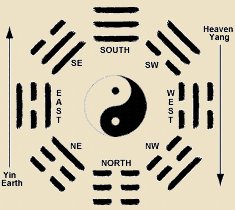
NOTE: In the directions column, NE (U) denotes the upper northeast direction, while NE (L) denotes the lower northeast direction. Same system for the other semi-directions. It was probably in Japan’s Edo Period (1603 - 1867 AD) when the 12 zodiac animals were each associated with one specific patron Buddhist deity, the Eight Buddhist Patron Protector Deities. I’m not sure when this system was actually adopted, but the eight include four guarding the four cardinal directions and four guarding the four semi-directions. The grouping likely originated in China. Why not assign 12 patron deities instead of eight? The most plausible reason involves Chinese Taoism, Feng Shui 風水 (geomancy), and divination, for there are eight interrelated symbols (or trigrams) in Chinese cosmology called the Bā Guà (Chn. = 八卦, Jp. = Hakka). Each consists of three lines and each is associated with either the yin or yang principle. The eight trigrams symbolize the unceasingly changing balance of forces and are used in divination. For details, see Divination below.
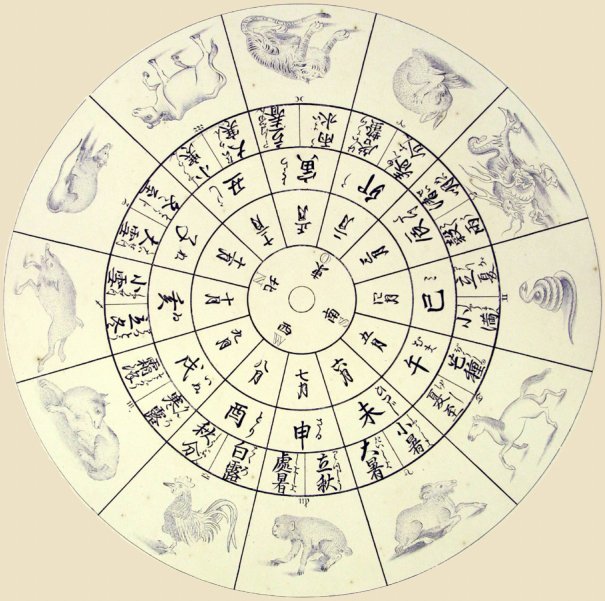
Zodiac Chart
As reproduced by Philipp Franz von Siebold.
Nippon Archiv zur Beschreibung von Japan. Leiden (1831 CE)
Photo Page | Index Page | Top Page
|
|

Lunar (Old) Versus Solar (New) Calendar
The lunar calendar (zodiac calendar) is based on the waxing and waning of the moon. There are 29 to 30 days per lunar month, with approximately a one-month disparity between the lunar and solar calendars. In Japan, the lunar calendar was abandoned in 1872 in favor of the solar, but even today many temples and shrines continue to use lunar dating for important festivals and events. In the lunar calendar, the new moon (1st of the month), the half-moon of the first quarter (7th or 8th), the full moon (15th), and the half-moon of the last-quarter (22nd or 23rd), are considered sacred days and known as Hare-no-hi 晴れの日. All other days of the months are known as Ke-no-hi 褻の日. Until modern times, Japan’s most important festivals were almost always held on Hare-no-hi days. People in former times believed the day began and ended from sunset to sunset, so festivals were normally held from the eve of the festival (yoi matsuri 宵祭り) into the daylight hours of the main festival day (hon matsuri 本祭り) -- with festivities ending at sunset on the main festival day. Thus, Hare-no-hi festivals typically lasted only 24 hours, from sunset to sunset.
|
|
Hare-no-hi 晴れの日
Sacred Days in Lunar Calendar
|
|
|

New
Moon
|

Half Moon
1st Qrt.
|

Full
Moon
|

Half Moon
3rd Qrt.
|
|
|
1st
|
7th or 8th
|
15th
|
22 or 23
|
|
|
|
|
|
|
|
Today, however, the situation is more complicated, for the lunar calendar is used by some locations, while the solar calendar is used by others. The three methods used today for dating important festivals and events are:
- One month is added to the lunar calendar. For example, if a festival occurred on May 1st in the lunar calendar, it will occur on June 1st using the solar calendar.
- The lunar calendar is still used to calculate the equivalent solar date. If the festival occurred on May 1st in the lunar calendar, it will be held on/about June 1 in the solar calendar.
- No change. If the festival occurred on May 1 in the lunar calendar, it will occur on May 1 in the solar calendar.
|
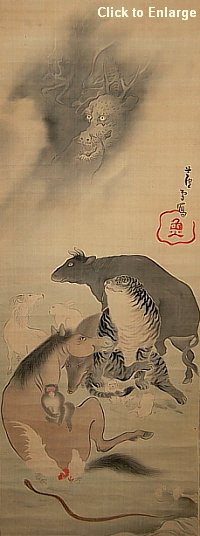
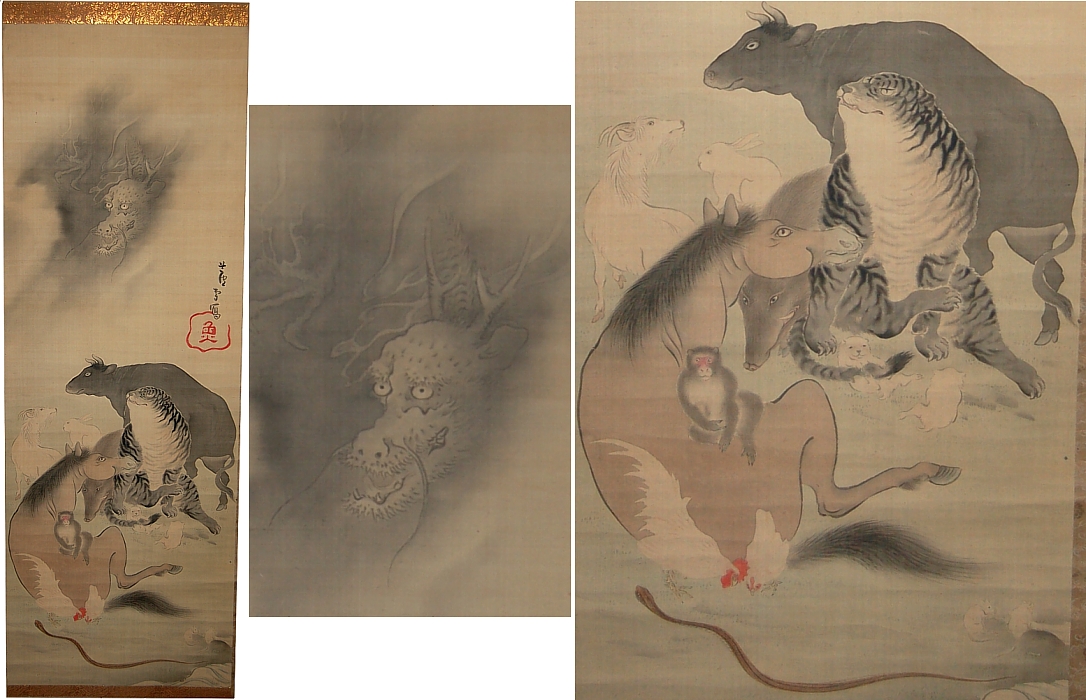
Scroll, Twelve Zodiac Animals,
by Nagasawa Rosetsu 長沢芦雪
(1754-1799), 18th century.
In private collection of US collector.
Provenance: Erik Thomsen, Europe
|
|
Is the Asian Zodiac Based on Constellations?
The Asian zodiac is not based on constellations, as is the Western (Greek/Roman) zodiac. The Asian calendar is based on the twelve yearly phases of the moon, known as the twelve-month lunar year (each month lasting between 28 to 31 days). The Western (Greek/Roman) calendar is based on the annual path of the sun through twelve star constellations, known as the solar year. East Asia’s calendar is also based on the Twenty-Eight Constellations or 28 Moon Lodges, which added greater precision.
Says famed author Isaac Asimov in Words from the Myths (1963) about the Western zodiac: "The heavens contain thousands of stars. These are 'fixed stars' since, unlike the planets, they do not change position with respect to one another. They form patterns that do not change, night after night and year after year. Shepherds and farmers, in prehistoric days, studied these patterns because they served as a calendar. The sun moves against the background of the stars and different stars are visible at night at different times of the year. The easiest way to handle the situation was to divide the stars into convenient groups which are nowadays called 'constellations' (from Latin words meaning 'with stars'). Then one could say that when one constellation rose in the east at sunset, it was harvest; the rising of another at sunset would indicate planting time and so on. The most important constellations in this connection would be those through which the sun actually passed on its path across the sky. There are twelve of these. The reason for the twelve is that the phases of the moon were also used to keep time. The moon went through its phases twelve times [per year] while the sun traveled through the constellations once. In other words, there are twelve months to the year and the sun spent one month in each of twelve constellations. The natural way of telling one constellation from another is to notice the pattern of stars in each one. It was inevitable that as time went on, people would begin to make complicated pictures out of these patterns. Eight stars arranged in a 'V' might seem to resemble the head of a bull with its horns. Stars arranged in a 'C' might suggest first a bow, and then an archer. As a result, many of the constellations are now pictured as animals or people. In fact the circle of twelve constellations through which the sun passes in its travels contains so many imaginary animals that it is called the 'zodiac' from Greek words meaning 'circle of animals.' The Greeks inherited most of these constellation-pictures from the Babylonians. What they then did was either to change the pictures to fit their own myths, or else invent myths to explain the pictures." <end quote, pp. 44-45>
Zodiac Trivia in Japan
-
Toshi Otoko 年男 and Toshi Onna 年女. The “partial” Zodiac is based on a 12-year cycle, each year associated with a particular Zodiac animal. Every 12 years, the Zodiac sign under which one is born comes around again. When this occurs, that is, when one’s Zodiac sign is the same as the current year, men are called Toshi Otoko and women are called Toshi Onna.
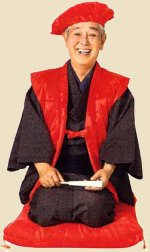
- Kanreki 還暦, or 60th Birthday Celebration. The “full” Zodiac is based on a 60-year cycle (five 12-year sub-cycles). When one reaches sixty years of age, the 60th birthday is called kanreki -- the recognition of one’s “second infancy.” The Japanese term kanreki 還暦 literally means “return 還” and “calendar 暦.” Phrased differently, the cycle of life returns to its starting point after 60 years, and as such, kanreki celebrates that point in a one’s life when one’s personal calendar has returned to the calendar sign under which one was born. Friends and relatives are traditionally invited for a celebratory feast on one’s 60th birthday, and it is customary for the celebrant to wear a red hood and red vest. These clothes are usually worn by babies and thus symbolize the celebrant’s return to his/her birth.
- In Chinese Zodiac cosmology, odd numbers are considered auspicious, and hence, major festival days and celebrations were held on odd days. This is known in Japan as Gosekku 五節句 (lit. = five seasonal festivals). The five main Japanese festivals of the old lunar calendar are:
1. First month, first day = Kochōhai 小朝拝, New Year Celebration.
2. Third month, third day = Kyokusui no en 曲水の宴, Drinking Around a Rolling Stream.
3. Fifth month, fifth day = Tango no sekku 端午の節句 or Boys' Festival.
4. Seventh month, seventh day = Kikkouden 乞功奠 or Tanabata 七夕 Festival.
5. Ninth month, ninth day = Chōyō no en 重陽の宴 or Feast of Chrysanthemuns.
Says JAANUS: Over the centuries several of the festivals have changed dates, for instance the seventh day after the New Year had been celebrated as Jinjitsu 人日 and the third month festival became the Hinamatsuri 雛祭 or Doll Festival. Documents reveal that paintings of the gosekku were produced in the Heian period. Among examples from the Edo period, Sakai Hōitsu's 酒井包一 (1761-1828) five hanging scrolls dated to 1827 (Ōkura Shūkokan 大倉集古館, Tokyo) are well known. The popular celebrations were often depicted by artists of woodblock prints (ukiyo-e 浮世絵). The gosekku were a popular pictorial theme in Edo period art. <end quote JAANUS>
DATE OF ARTWORK. As a method for dating, the 60-year Zodiac cycle is crucial to modern art historians, for it helps them date artwork from much earlier times. To wit, the online dictionary JAANUS says this: “The zodiac system is important in art history for dating artwork. For example, according to the halo inscription on the bronze statues of Shaka Nyorai (Historical Buddha) and his attendant at the Daihōzōden 大宝蔵殿 (part of Hōryūji Temple 法隆寺), the statues were made in the year of Boshi 戊子 for Japanese Minister Soga 蘇我. Since the statues are in the very early Asuka 飛鳥 style and the Soga clan flourished until the mid-7th century AD, the year of Boshi can be pinpointed to 628 AD.” <end JAANUS quote>
|
|
|
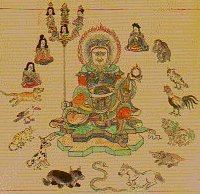 ZODIAC COMPONENTS ZODIAC COMPONENTS
The Zodiac is based on a number of important Chinese systems of thought that were transmitted to Japan along with Confucian, Taoist, and Buddhist philosophies between the 6th and 8th centuries AD. The main components are discussed in order below, followed by a calenderic chart that combines all these elements for the years 1924 through 2043:
TEN STEMS or TEN HEAVENLY STEMS. The ten stems are a cyclic numeric system that date back to China’s Shang Dynasty (1600 - 1046 BC). They correspond to the ten days of the ten-day week used by Shang rulers (these days relate to ten suns that appeared in a ten-day cycle in ancient Chinese mythology). The stem names also appear in the names given the early Shang kings. The ten are combined with the 12 zodiac animals (the “12 Branches,” see below) to form 60 two-symbol units. Each unit represents a year in the Zodiac calendar, and the 60-year cycle is known as the sexagenary cycle. The cycle was repeated ad infinitum for counting years in China. In Japan, the sexagenary system was adopted in 604 AD by Empress Suiko, and is known as Jikkan Jūnishi 十干十二支 (literally “10 stems and 12 branches”). The current 60-year cycle started in 1984. Alternate readings (names) for the ten stems were derived by combining the Five Elements with yin-yang dualism, yielding ten “alternate” combinations. For a complete listing of the 10 stems and 12 branches, see lunar charts below.
|
TEN STEMS (Jp. = Jikkan 十干)
|
|
|
Japan (Chinese) Reading
|
STEM
|
ASSOCIATIONS
|
|
1. Kō (Jiǎ)
|
甲
|
yang, wood
|
|
2. Otsu (Yǐ)
|
乙
|
yin, wood
|
|
3. Hei (Bǐng)
|
丙
|
yang, fire
|
|
4. Tei (Dīng)
|
丁
|
yin, fire
|
|
5. Bo (Wù)
|
戊
|
yang, earth
|
|
6. Ki (Jǐ)
|
己
|
yin, earth
|
|
7. Kō (Gēng)
|
庚
|
yang, metal
|
|
8. Shin (Xīn)
|
辛
|
yin, metal
|
|
9. Jin (Rén)
|
壬
|
yang, water
|
|
10. Ki (Guǐ)
|
癸
|
yin, water
|
|
 TWELVE BRANCHES, TWELVE ANIMALS TWELVE BRANCHES, TWELVE ANIMALS
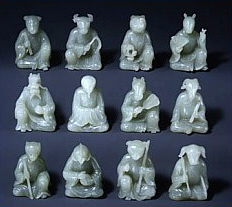
The 12 branches (animals) are combined with the above 10 stems to form 60 two-symbol units. Each unit represents a year in the zodiac calendar, and the 60-year cycle is known as the sexagenary cycle. The twelve branches correspond to the twelve stations Jupiter passes through in one revolution around the sun, which were in turn associated with the 12 animals. At the same time, each Zodiac animal represents one year of a twelve-year cycle, a day in a twelve-day cycle, a two-hour period in each day, and a compass direction. Says the Metropolitan Museum of Art in New York: “The twelve animals of the Chinese zodiac are well-known symbols associated with forecasting people's futures and determining their character. By the 4th century BC, they were well established in Chinese thought. The earliest depictions appear in ceiling paintings from a tomb dated 533 BC. During the Tang dynasty, pottery representations of these symbols were placed in tombs, reflecting the court's fascination with divination and astrology.” <End quote by Metropolitan Museum of Art. The above photo of the Twelve Zodiac Animals comes from the museum as well; Qing dynasty (1644-1911); 19th century; Nephrite; Gift of Heber R. Bishop, 1902>
|
|
|
|
|
|
|
|
|
|
|
TWELVE BRANCH ANIMALS / SIGNS (Jp. = Jūnishi 十二支)
Each of the 12 is also associated with hours in the day, months of the year, compass direction, others.
|
|
#
|
Zodiac Animal
Japanese Language
Official (Common)
|
Zodiac Animal
Chinese Language
Official (Common)
|
Hours
of Day
|
Month
of Year
|
Compass
Direction
|
Yin &
Yang
|
Buddhist
Patron
|
Fixed
Element
|
|
1
|
Rat 子 = Shi (Ne, Nezumi)
|
Zǐ 子 (Shǔ 鼠)
|
23-1
|
Nov.
|
N
|
Yang 陽
|
S. Kannon
|
Water 水
|
|
2
|
Ox 丑 = Chū (Ushi)
|
Chǒu 丑 (Niú 牛)
|
1-3
|
Dec.
|
NE (U)
|
Yin 陰
|
Kokūzō
|
Water 水
|
|
3
|
Tiger 寅 = In (Tora)
|
Yīn 寅 (Hǔ 虎)
|
3-5
|
Jan.
|
NE (L)
|
Yang 陽
|
Kokūzō
|
Wood 木
|
|
4
|
Hare/Rabbit 卯 = Bō (U, Usagi)
|
Mǎo 卯 (Tù 兎)
|
5-7
|
Feb.
|
E
|
Yin 陰
|
Monju
|
Wood 木
|
|
5
|
Dragon 辰 = Shin (Tatsu, Ryū)
|
Chén 辰 (Lóng 龍)
|
7-9
|
March
|
SE (U)
|
Yang 陽
|
Fugen
|
Wood 木
|
|
6
|
Snake 巳 = Shi (Mi, Hebi)
|
Sì 巳 (Shé 蛇)
|
9-11
|
April
|
SE (L)
|
Yin 陰
|
Fugen
|
Fire 火
|
|
7
|
Horse 午 = Go (Uma)
|
Wǔ 午 (Mǎ 馬)
|
11-13
|
May
|
S
|
Yang 陽
|
Seishi
|
Fire 火
|
|
8
|
Sheep, Ram 未 = Bi (Hitsuji)
|
Wèi 未 (Yáng 羊)
|
13-15
|
June
|
SW (L)
|
Yin 陰
|
Dainichi
|
Fire 火
|
|
9
|
Monkey 申 = Shin (Saru)
|
Shēn 申 (Hóu 候)
|
15-17
|
July
|
SW (U)
|
Yang 陽
|
Dainichi
|
Metal 金
|
|
10
|
Rooster, Cock 酉 = Yū (Tori)
|
Yǒu 酉 (Ji 鸡)
|
17-19
|
Aug.
|
W
|
Yin 陰
|
Fudō
|
Metal 金
|
|
11
|
Dog 戌 = Jutsu (Inu)
|
Xū 戌 (Gǒu 狗, Quǎn犬)
|
19-21
|
Sept.
|
NW (L)
|
Yang 陽
|
Amida
|
Metal 金
|
|
12
|
Boar, Pig 亥 = Gai (I, Inoshishi)
|
Hài 亥 (Zhū 猪, Tún 豚)
|
21-23
|
Oct.
|
NW (U)
|
Yin 陰
|
Amida
|
Water 水
|
|
NOTE 1: In the directions column, NE (U) denotes the upper northeast direction, while NE (L) denotes the lower northeast direction. Same system for the other semi-directions.
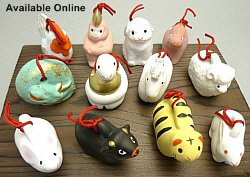 NOTE 2: In Buddhism, the dragon and snake are both members of the Naga family of serpentine creatures; originated in Hindu mythology. NOTE 2: In Buddhism, the dragon and snake are both members of the Naga family of serpentine creatures; originated in Hindu mythology.
Each Zodiac animal represents one year in a 12-year cycle, a day in a twelve-day cycle, a two-hour period in each day, and a compass direction. The day, for example, starts at twelve midnight, and corresponds to the Rat. Every two hours, it moves to the next zodiac animal, with twelve noon associated with the Horse. When it comes to compass directions, the Rat signifies due north, and every 30 degrees clockwise it moves to the next zodiac animal.
Temples and shrines perform many of their services and festivals on specific zodiac animal days. For example, Inari shrines hold their annual festivals on the first horse day in February, while Benzaiten shrines hold their yearly festival on the first Snake day in February. Inari shrines are dedicated to Oinari (food/fox deity), while Benzaiten shrines are devoted to the water goddess Benzaiten, who is closely associated with both the snake and dragon.
|
|
FIVE ELEMENTS
YIN-YANG DUALISM, AND TAOISM
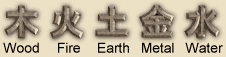
The five elements 五行 (Jp = Gogyō, Ch = Wǔxíng) are wood, fire, earth, metal, and water. The five were combined with the binary Yin-Yang system -- Yin 陰 (Jp = in) and Yang 陽 (Jp = yō) -- resulting in ten “alternative” readings for the ten stems. See below chart for these alternative readings. In the 60-year cycle, odd years were classified as YANG years, even years as YIN. Even today, when the 60-year cycle reaches completion, some people in Japan who are 60-years of age hold a special birthday ceremony called kanreki 還暦. Additionally, Chinese ideas of illness, especially Taoist notions of illness as caused by imbalances of yin and yang forces in the body, were introduced to Japan probably by the late Nara or early Heian periods. Taoist notions embodied various concepts of the Zodiac calendar. Click here for an example of Taoist traditions based on the Zodiac calendar.
In China, the first celebrated exponent of the five-element theory was Tsou Yen (350 - 270 BC). The five energies were symbolized as (1) wood, which as fuel gives rise to (2) fire, which creates ash and gives rise to (3) earth, which in its mines contains (4) metal, which (as on the surface of a metal mirror) attracts dew and so gives rise to (5) water, and this in turn nourishes (1) wood. This is called hsiang sheng (相生), or the “mutually arising” order/cycle of the fundamental forces. These forces were also arranged in the order of “mutual conquest” (相勝) -- likewise read hsiang sheng, but sheng is a different ideogram -- in which (1) wood, in the form of a plow, overcomes (2) earth, which, by damming and constraint, conquers (3) water which, by quenching, overcomes (4) fire which, by melting, liquifies (5) metal, which, in turn, cuts (1) wood. <quoted from “TAO, The Watercourse Way” by Alan Watts>
|
FIVE ELEMENTS (五行; JP = Gogyō, Ch = Wǔxíng, Wu Hsing)
The five major planets were associated with the Five Elements.
|
|
Wood (ki 木)
Fire (hi 火)
Earth (tsuchi 土)
Metal (kane 金)
Water (mizu 水)
|
Jupiter
Mars
Saturn
Venus
Mercury
|
|
NOTE: In Chinese astrology, one's destiny is determined by numerous factors, including the position of the major planets, the sun and moon, and comets at the time of one’s birth, along with the time of one’s birth and other influences.
|
|
TEN HEAVENLY STEMS -- ALTERNATE READINGS
FIVE ELEMENTS COMBINED WITH YIN-YANG DUALISM
Yin 陰 (Jp = in). Feminine, passive, negative, etc. Yang 陽 (Jp: you) Male, aggressive, positive, etc.
The ten stems were given alternate names by combining the binary yin-yang principle to each of the five elements. The yang "e" 兄 (elder) and yin "to" 弟 (younger) were joined with each element, resulting in ten possible combinations.
|
|
Wood (ki 木)
|
ki-no-e 甲 (yang)
|
|
Wood (ki 木)
|
ki-no-to 乙 (yin)
|
|
Fire (hi 火)
|
hi-no-e 丙 (yang)
|
|
Fire (hi 火)
|
hi-no-to 丁 (yin)
|
|
Earth (tsuchi 土)
|
tsuchi-no-e 戊 (yang)
|
|
Earth (tsuchi 土)
|
tsuchi-no-to 己 (yin)
|
|
Metal (kane 金)
|
kano-e 庚 (yang)
|
|
Metal (kane 金)
|
kano-to 辛 (yin)
|
|
Water (mizu 水)
|
mizu-no-e 壬 (yang)
|
|
Water (mizu 水)
|
mizu-no-to 癸 (yin)
|
|
The five-elements theory in following centuries was combined in various groupings with the Guardian Spirits of the Four Cardinal Points. The combinations differ by cult and country, and often involve the primary colors, parts of the body, seasons of the year, and other attributes.
- Wood, East, Spring, Green-Blue, Dragon
Planet Jupiter, Liver & Gall
- Fire, South, Summer, Red, Red Bird or Phoenix)
Planet Mars, Heart and Large Intestines
- Metal, West, Autumn, White, Tiger
Planet Venus, Lungs and Small Intestine
- Water, North, Winter, Black, Tortoise, Cold
Planet Mercury, Kidneys and Bladder
- Earth, Center, Yellow, Planet Saturn, Hips
<this entry not yet fully confirmed>
- < Source: China and Japan Myths and Legends by Donald A. Mackenzie; ISBN: 1851700161 >
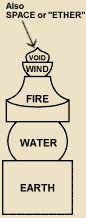 Five-Elements in Esoteric Buddhism. Elsewhere, in Japan, there is another five-element Buddhist concept related to five-tier pagodas and stupas, with a somewhat different set of five elements. Each piece in the five-story pagoda (Sanskrit = stupa) corresponds to one of five elements in the traditions of Esoteric Buddhism (Shingon and Tendai sects). The bottom story is square and corresponds to the earth ring (Japanese = Chirin 地輪). Next is the spherical water ring (Japanese = Suirin 水輪), surmounted by the triangular ring of fire (Japanese = Karin 火輪). Above this is a reclining half-moon shape (Japanese = Fuurin 風輪), representing the wind, and topmost is the gem-shaped ring of space (Japanese = Kuurin 空輪). Click here for details. Five-Elements in Esoteric Buddhism. Elsewhere, in Japan, there is another five-element Buddhist concept related to five-tier pagodas and stupas, with a somewhat different set of five elements. Each piece in the five-story pagoda (Sanskrit = stupa) corresponds to one of five elements in the traditions of Esoteric Buddhism (Shingon and Tendai sects). The bottom story is square and corresponds to the earth ring (Japanese = Chirin 地輪). Next is the spherical water ring (Japanese = Suirin 水輪), surmounted by the triangular ring of fire (Japanese = Karin 火輪). Above this is a reclining half-moon shape (Japanese = Fuurin 風輪), representing the wind, and topmost is the gem-shaped ring of space (Japanese = Kuurin 空輪). Click here for details.
 DIVINATION DIVINATION
Known as Onmyōdō 陰陽道 in Japan
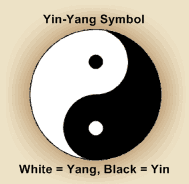
The binary Yin-Yang system is nearly as old as China itself. It is the central pillar of all Chinese systems of divination, and a key element in Chinese philosophy. In the Chinese Book of Changes (I Ching 易經), the yang principle is represented by a straight line _____ and the yin principle by a broken line __ __. The two are combined into abstract line arrangements (hexagrams and trigrams) with various meanings. Certain combinations are auspicious, others inauspicious. Different methods are used to "cast" a reading. These trigrams, over time, were developed into a complex system composed of 64 hexagrams 六十四卦. The trigrams number eight, and in Chinese cosmology are called the Bā Guà (Chn. = 八卦, Jp. = Hakka). Each consists of three lines and each is associated with either the yin or yang principle, and related in various ways to the Five Elements. The eight trigrams symbolize the unceasingly changing balance of forces and are used in divination. They appear in two different versions -- the “Earlier Heaven” arrangement used for burial sites and the “Later Heaven” arrangement used for residences. They were also combined with the Zodiac system (this combination is not discussed herein, but photos are shown below).
|
☰
|
☱
|
☲
|
☳
|
☴
|
☵
|
☶
|
☷
|
|
Qián 乾
|
Duì 兌
|
Lí 離
|
Zhèn 震
|
Xùn 巽
|
Kǎn 坎
|
Gèn 艮
|
Kūn 坤
|
|
Heaven/Sky
|
Lake/Marsh
|
Fire
|
Thunder
|
Wind
|
Water
|
Mountain
|
Earth
|
|
Pure Yang
|
|
Middle Yin
|
|
|
Middle Yang
|
|
Pure Yin
|
|
Creative
|
|
|
|
|
|
|
Receptive
|
|
NOTE: Still under development.
|
|
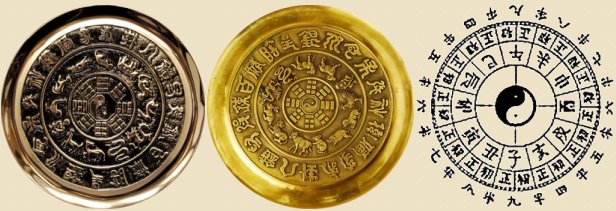
The eight trigrams were combined with the 12 Zodiac animals, divination schemes, compass systems, & others. Above
we see both modern & old systems used in China. Photos (L to R): tenpodo.com, wisecart.ne.jp, & web site (now dead)
Zodiac Belief and the Cult of the Big Dipper
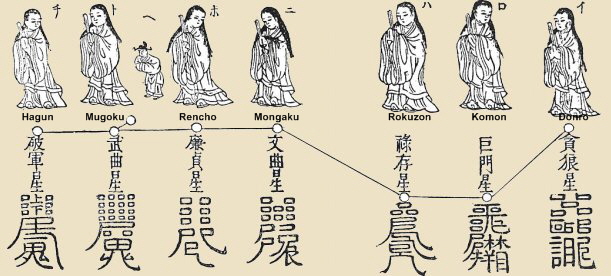
In Japan’s Heian period (794-1185), Zodiac belief was combined with worship of the seven stars of the Big Dipper, which were said to control one’s human destiny. In the Sutra of the Big Dipper for Prolonging Life (Hokuto Shichisei Enmei-Kyō 北斗七星延命経), each of the seven stars was combined with the zodiac signs, thereby yielding one’s personal star based on one’s birth star (Honmyōshō 本命星):
Seven deities of the Big Dipper. Photo Source: T-21, no. 1306, pp. 425-426
|
Deifications of the Seven Stars of the Big Dipper & Their Zodiac Associations
|
|
Japanese Name
|
Sino-Japanese Spelling
|
Zodiac Animal
|
|
Donrō shō
|
貪狼星
|
Rat
|
|
Komon shō
|
巨門星
|
Ox, Pig
|
|
Rokuzon shō
|
禄存星
|
Tiger, Dog
|
|
Mongoku shō
|
文曲星
|
Hare, Cockrell
|
|
Renchō shō
|
廉貞星
|
Dragon, Monkey
|
|
Mugoku shō
|
武曲星
|
Snake, Sheep
|
|
Hagun shō
|
破軍星
|
Horse
|
|
Source: Hokuto Shichisei Enmei-Kyō 北斗七星延命経, T-21, no. 1306, pp. 425-426
|
|
|
PUTTING IT ALL TOGETHER
60-YEAR ZODIAC LUNAR CYCLE FROM 1984 TO 2043
10 Stems, 12 Branches (Animals), Yin-Yang, Five Elements, Months, Directions, Hours.
Buddhist Patron Listed Below Animal Sign. Dates in Year / Month / Day Format.
|
|
Rat
Senju
|
Ox
Kokūzō
|
Tiger
Kokūzō
|
Hare
Monju
|
Dragon
Fugen
|
Snake
Fugen
|
Horse
Seishi
|
Sheep
Dainichi
|
Monkey
Dainichi
|
Rooster
Fudō
|
Dog
Amida
|
Boar
Amida
|
|
Nov.
|
Dec.
|
Jan.
|
Feb.
|
March
|
April
|
May
|
June
|
July
|
Aug.
|
Sept.
|
Oct.
|
|
N
|
NE (U)
|
NE (L)
|
E
|
SE (U)
|
SE (L)
|
S
|
SW (L)
|
SW (U)
|
W
|
NW (L)
|
NW (U)
|
|
23-1
|
1-3 am
|
3-5 am
|
5-7 am
|
7-9 am
|
9-11 am
|
11-13
|
13-15 pm
|
15-17 pm
|
17-19 pm
|
19-21 pm
|
21-23 pm
|
|
1
84.2.2
甲子
Yang
Wood
|
2
85.2.20
乙丑
Yin
Wood
|
3
86.2.9
丙寅
Yang
Fire
|
4
87.1.29
丁卯
Yin
Fire
|
5
88.2.17
戊辰
Yang
Earth
|
6
89.2.6
己巳
Yin
Earth
|
7
90.1.27
庚午
Yang
Metal
|
8
91.2.15
辛未
Yin
Metal
|
9
92.2.4
壬申
Yang
Water
|
10
93.1.23
癸酉
Yin
Water
|
11
94.2.10
甲戌
Yang
Wood
|
12
95.1.31
乙亥
Yin
Wood
|
|
13
96.2.19
丙子
Yang
Fire
|
14
97.2.7
丁丑
Yin
Fire
|
15
98.1.28
戊寅
Yang
Earth
|
16
99.2.16
己卯
Yin
Earth
|
17
00.2.5
庚辰
Yang
Metal
|
18
01.1.24
辛巳
Yin
Metal
|
19
02.2.12
壬午
Yang
Water
|
20
03.1.1
癸未
Yin
Water
|
21
04.1.22
甲申
Yang
Wood
|
22
05.2.9
乙酉
Yin
Wood
|
23
06.1.29
丙戌
Yang
Fire
|
24
07.2.18
丁亥
Yin
Fire
|
|
25
08.2.7
戊子
Yang
Earth
|
26
09.1.26
己丑
Yin
Earth
|
27
10.2.14
庚寅
Yang
Metal
|
28
11.2.3
辛卯
Yin
Metal
|
29
12.1.23
壬辰
Yang
Water
|
30
13.2.10
癸巳
Yin
Water
|
31
14.1.31
甲午
Yang
Wood
|
32
15.2.19
乙未
Yin
Wood
|
33
16.2.8
丙申
Yang
Fire
|
34
17.1.28
丁酉
Yin
Fire
|
35
18.2.19
戊戌
Yang
Earth
|
36
19.2.5
己亥
Yin
Earth
|
|
37
20.1.25
庚子
Yang
Metal
|
38
21.2.12
辛丑
Yin
Metal
|
39
22.2.1
壬寅
Yang
Water
|
40
23.1.22
癸卯
Yin
Water
|
41
24.2.10
甲辰
Yang
Wood
|
42
25.1.29
乙巳
Yin
Wood
|
43
26.2.17
丙午
Yang
Fire
|
44
27.2.6
丁未
Yin
Fire
|
45
28.1.26
戊申
Yang
Earth
|
46
29.2.13
己酉
Yin
Earth
|
47
30.2.3
庚戌
Yang
Metal
|
48
31.1.23
辛亥
Yin
Metal
|
|
49
32.2.11
壬子
Yang
Water
|
50
33.1.31
癸丑
Yin
Water
|
51
34.2.19
甲寅
Yang
Wood
|
52
35.2.8
乙卯
Yin
Wood
|
53
36.1.28
丙辰
Yang
Fire
|
54
37.2.15
丁巳
Yin
Fire
|
55
38.2.4
戊午
Yang
Earth
|
56
39.1.24
己未
Yin
Earth
|
57
40.2.12
庚申
Yang
Metal
|
58
41.2.1
辛酉
Yin
Metal
|
59
42.1.22
壬戌
Yang
Water
|
60
43.2.10
癸亥
Yin
Water
|
|
NOTES: Dates from 1984 to 2043 in Year / Month / Day Format. In above chart, the 57th year is known as KŌSHIN. It is a Monkey Year of great misfortune. The next Kōshin year occurs in 2040 AD. Details here. The 60-year (sexagenary) cycle gets more complicated when the alternate ten stems (derived by combining the five elements & yin-yang dualism) are used. In this latter system, six of the animals are associated with the "yang" element and six with the "yin" element -- they are either yang or yin, but never both. Details here. The above chart includes the yang-yin associations. In the directions row, NE (U) denotes the upper northeast direction, while NE (L) denotes the lower northeast direction. Same system for the other semi-directions. Finally, the Chinese have yet another Zodiac calendar, the agricultural calendar (not discussed herein), which approximates to the lunar calendar, but not exactly.
BE CAREFUL USING THIS CHART. Here is one example: Say you were born on Jan. 19, 1987. Your sign is thus the TIGER, not the HARE. If you review the above chart, you will see that everyone born between 1986 (Feb. 9) and 1987 (Jan. 29) falls into the TIGER category. Even though you were born in the year of the HARE (1987), you are still a TIGER based on the lunar calendar. Therefore, be careful using this chart. If you are still unsure, please click here.
|
|
|
|
|
|
|
|
|
|
|
|
|
|
|
|
PUTTING IT ALL TOGETHER
60-YEAR ZODIAC LUNAR CYCLE FROM 1924 TO 1983
10 Stems, 12 Branches (Animals), Yin-Yang, Five Elements, Months, Directions, Hours.
Buddhist Patron Listed Below Animal Sign. Dates in Year / Month / Day Format.
|
|
Rat
Senju
|
Ox
Kokūzō
|
Tiger
Kokūzō
|
Hare
Monju
|
Dragon
Fugen
|
Snake
Fugen
|
Horse
Seishi
|
Sheep
Dainichi
|
Monkey
Dainichi
|
Rooster
Fudō
|
Dog
Amida
|
Boar
Amida
|
|
Nov.
|
Dec.
|
Jan.
|
Feb.
|
March
|
April
|
May
|
June
|
July
|
Sept.
|
Oct.
|
Dec.
|
|
N
|
NE (U)
|
NE (L)
|
E
|
SE (U)
|
SE (L)
|
S
|
SW (L)
|
SW (U)
|
W
|
NW (L)
|
NW (U)
|
|
23-1
|
1-3 am
|
3-5 am
|
5-7 am
|
7-9 am
|
9-11 am
|
11-13
|
13-15 pm
|
15-17 pm
|
17-19 pm
|
19-21 pm
|
21-23 pm
|
|
1
24.2.5
甲子
Yang
Wood
|
2
25.1.24
乙丑
Yin
Wood
|
3
26.2.13
丙寅
Yang
Fire
|
4
27.2.2
丁卯
Yin
Fire
|
5
28.1.22
戊辰
Yang
Earth
|
6
29.2.10
己巳
Yin
Earth
|
7
30.1.30
庚午
Yang
Metal
|
8
31.2.17
辛未
Yin
Metal
|
9
32.2.6
壬申
Yang
Water
|
10
33.1.26
癸酉
Yin
Water
|
11
34.2.14
甲戌
Yang
Wood
|
12
35.2.4
乙亥
Yin
Wood
|
|
13
36.1.24
丙子
Yang
Fire
|
14
37.2.11
丁丑
Yin
Fire
|
15
38.1.31
戊寅
Yang
Earth
|
16
39.2.19
己卯
Yin
Earth
|
17
40.2.8
庚辰
Yang
Metal
|
18
41.1.27
辛巳
Yin
Metal
|
19
42.2.15
壬午
Yang
Water
|
20
43.2.5
癸未
Yin
Water
|
21
44.1.25
甲申
Yang
Wood
|
22
45.2.13
乙酉
Yin
Wood
|
23
46.2.2
丙戌
Yang
Fire
|
24
47.1.22
丁亥
Yin
Fire
|
|
25
48.2.10
戊子
Yang
Earth
|
26
49.1.29
己丑
Yin
Earth
|
27
50.2.17
庚寅
Yang
Metal
|
28
51.2.6
辛卯
Yin
Metal
|
29
52.1.27
壬辰
Yang
Water
|
30
53.2.14
癸巳
Yin
Water
|
31
54.2.3
甲午
Yang
Wood
|
32
55.1.24
乙未
Yin
Wood
|
33
56.2.12
丙申
Yang
Fire
|
34
57.1.31
丁酉
Yin
Fire
|
35
58.2.18
戊戌
Yang
Earth
|
36
59.2.8
己亥
Yin
Earth
|
|
37
60.1.28
庚子
Yang
Metal
|
38
61.2.15
辛丑
Yin
Metal
|
39
62.2.5
壬寅
Yang
Water
|
40
63.1.25
癸卯
Yin
Water
|
41
64.2.13
甲辰
Yang
Wood
|
42
65.2.2
乙巳
Yin
Wood
|
43
66.1.21
丙午
Yang
Fire
|
44
67.2.9
丁未
Yin
Fire
|
45
68.1.30
戊申
Yang
Earth
|
46
69.2.17
己酉
Yin
Earth
|
47
70.2.6
庚戌
Yang
Metal
|
48
71.1.27
辛亥
Yin
Metal
|
|
49
72.2.15
壬子
Yang
Water
|
50
73.2.3
癸丑
Yin
Water
|
51
74.1.23
甲寅
Yang
Wood
|
52
75.2.11
乙卯
Yin
Wood
|
53
76.1.31
丙辰
Yang
Fire
|
54
77.2.18
丁巳
Yin
Fire
|
55
78.2.7
戊午
Yang
Earth
|
56
79.1.28
己未
Yin
Earth
|
57
80.2.16
庚申
Yang
Metal
|
58
81.2.5
辛酉
Yin
Metal
|
59
82.1.25
壬戌
Yang
Water
|
60
83.2.13
癸亥
Yin
Water
|
|
NOTES: Dates from 1924 to 1983 in Year / Month / Day Format. In above chart, the 57th year is known as KŌSHIN. It is a Monkey Year of great misfortune. The next Kōshin year occurs in 2040 AD. Details here. The 60-year (sexagenary) cycle gets more complicated when the alternate ten stems (derived by combining the five elements & yin-yang dualism) are used. In this latter system, six of the animals are associated with the "yang" element and six with the "yin" element -- they are either yang or yin, but never both. Details here. The above chart includes the yang-yin associations. In the directions row, NE (U) denotes the upper northeast direction, while NE (L) denotes the lower northeast direction. Same system for the other semi-directions. For dates prior to 1924, please click here. Finally, the Chinese had yet another Zodiac calendar, the agricultural calendar (not discussed herein), which approximates to the lunar calendar, but not exactly.
BE CAREFUL USING THIS CHART. Here is one example: Say you were born on Jan. 28, 1964. Your sign is thus the HARE, not the DRAGON. If you review the above chart, you will see that everyone born between 1963 (Jan. 25) and 1964 (Feb. 13) falls into the RABBIT category. Even though you were born in the year of the Dragon (1964), you are still a RABBIT based on the lunar calendar. Therefore, be careful using this chart. If you are still unsure, please click here.
|
|
|
|
|
|
|
|
|
|
|
|
|
|
|
 ZODIAC GOOD/BAD DAYS ZODIAC GOOD/BAD DAYS
MONKEY MISFORTUNE
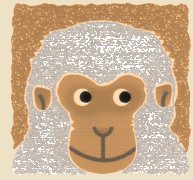
In the Zodiac, yin-yang dualism is combined with the five elements to obtain ten “alternate” readings for the ten stems (see above). In the 60-year cycle of the Zodiac calendar, days and years are further divided into those of great fortune and misfortune, mediocre luck or misfortune, and neutral luck or misfortune. For example, certain Zodiac days of great misfortune in Japan are known as Kōshin days 庚申 (Ch: keng-shen or geng-shen). They occur six times yearly, and once every 60 years, and special rites -- influenced greatly by Chinese Taoist and Zodiac beliefs -- are performed on these days to ward off evil influences. One of the main players is the monkey, for the term Kōshin 庚申 is comprised of two characters -- Kō 庚, the stem associated with metal and the planet Venus, and Shin 申, the ninth symbol of the Chinese zodiac and the character for “monkey.” In Taoist traditions based on the Zodiac calendar, on the eve of a Kōshin Day, three worms (三蟲) believed to dwell in the human body escape from the body and visit the Court of Heaven to report on the sleeping person's sins. Depending on this report, the court might shorten that individual's life. To prevent this, people stayed awake all night on the eve of a Kōshin day, and this practice eventually became known as the Kōshin Machi (Kōshin Vigil, Kōshin Wake, 庚申會). In Japan, such beliefs were recorded by the late Heian era, but became particularly widespread during Japan's Edo period (1600-1868 AD), when people regularly tried to determine auspicious or inauspicious times before beginning activities (such as a new business or marriage). See the Monkey Pages for many more details.
Yakudoshi 厄年
Text courtesy of Japanese Cultural Center of Hawaii http://www.jcch.com/jt.htm
Bad luck ages are referred to as yakudoshi, with yaku meaning “calamity” or “calamitous” and doshi signifying “year(s).” These years are considered critical or dangerous because they are believed to bring bad luck or disaster. For men, the ages 24 and 41 in China (or 25 and 42 in Japan) are deemed critical years, with 41 being especially critical. It is customary in these unlucky years to visit temples and shrines to provide divine protection from harm. The birthday person should wear red to bring good health, vitality and long life. The equivalent yakudoshi ages for women are 18 and 32 (19 and 33 in Japan), with 32 thought to be a particularly hard, terrible or disastrous year. Like the age 41 for men, precautions are taken to ward off bad luck.
Kanreki 還暦
Text courtesy of Japanese Cultural Center of Hawaii, http://www.jcch.com/jt.htm
For men, the 60th birthday is called kanreki, the recognition of his “second infancy.” The Japanese characters in the word kanreki literally mean “return” and “calendar.” The traditional calendar, which was based on the Chinese calendar, was organized on 60-year cycles. The cycle of life returns to its starting point in 60 years, and as such, kanreki celebrates that point in a man’s life when his personal calendar has returned to the calendar sign under which he was born. Traditionally, friends and relatives are invited for a celebratory feast on one’s 60th birthday. It is customary for the celebrant to be given a red hood and wear a red vest. These clothes are usually worn by babies and thus symbolize the celebrant’s return to his birth. <end quote from Japanese Cultural Center of Hawaii>
 MERGING OF MERGING OF
BUDDHIST & ZODIAC SYMBOLISM
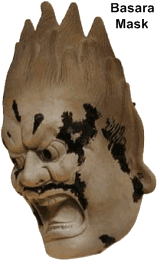
In China, from the Sui Dynasty (581-618 AD) onward, Buddhist images of the 12 Heavenly Generals of Yakushi Buddha were associated with the twelve Zodiac animals. But in Japan, this association between the 12 Generals and the 12 animals does not emerge until the Kamakura Period (1185 - 1333 AD), after which the astrological animals often appear in the head pieces of the 12 Generals. See M. W. de Visser's charts relating the Twelve Yaksa to zodiac signs in “Ancient Buddhism in Japan, Vol. II” (Leiden: 1935, pp. 551-553).
Much later, probably in the Edo Period (1603 - 1867), the 12 animals were each associated with one specific patron Buddhist deity, the Eight Buddhist Protector Deities. I’m not exactly sure when this latter system was adopted, but the eight include four guarding the four cardinal directions and four guarding the four semi-directions. It likely originated much earlier in China, but I’ve been unable to confirm this.

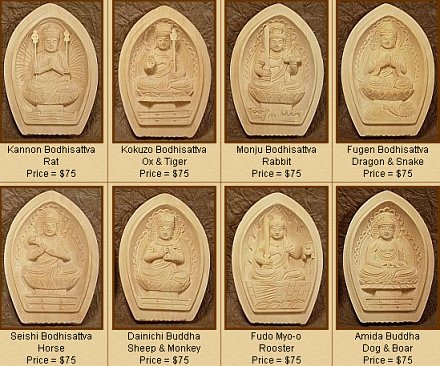
Amulets of Each Zodiac Patron
Available for Online Purchase
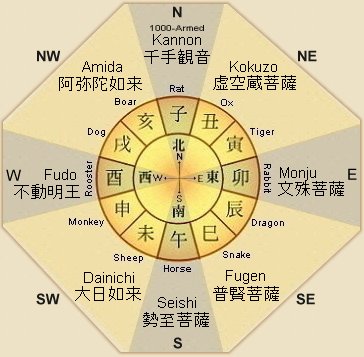
Eight Buddhist Deities and the 12 Zodiac Creatures
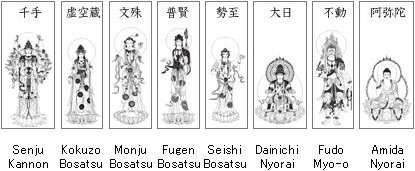
Artwork of the Eight Buddhist Deities by Modern Buddhist Artist Horie Yasutaka
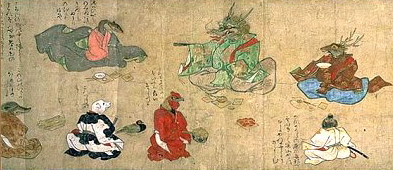
Poetry Contest, Zodiac Emaki (Hand Scroll), Edo Period. Photo: Kyoto Nat’l Museum.
LEARN MORE
|
|