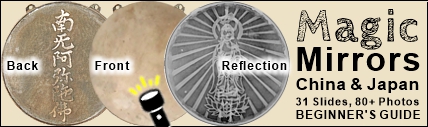
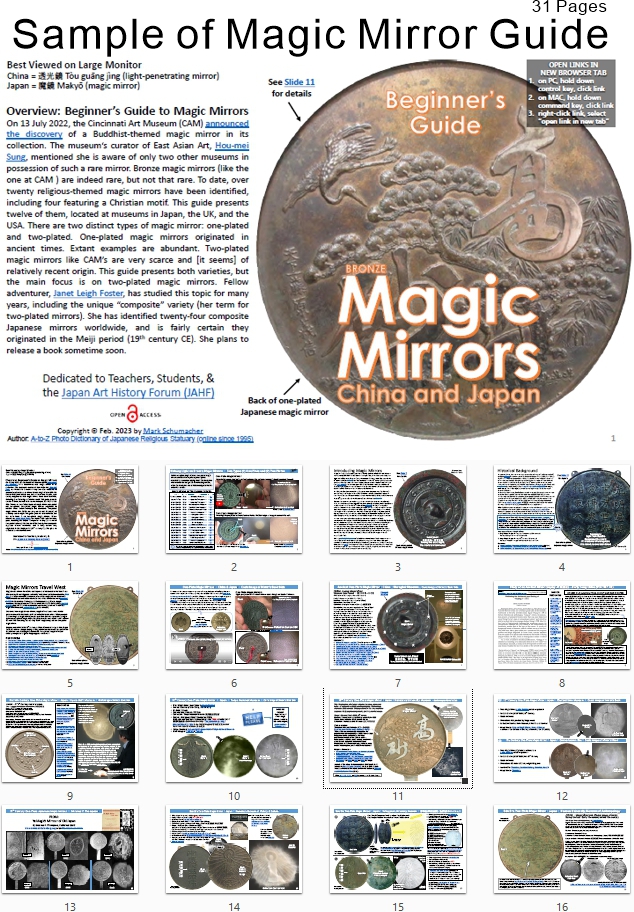
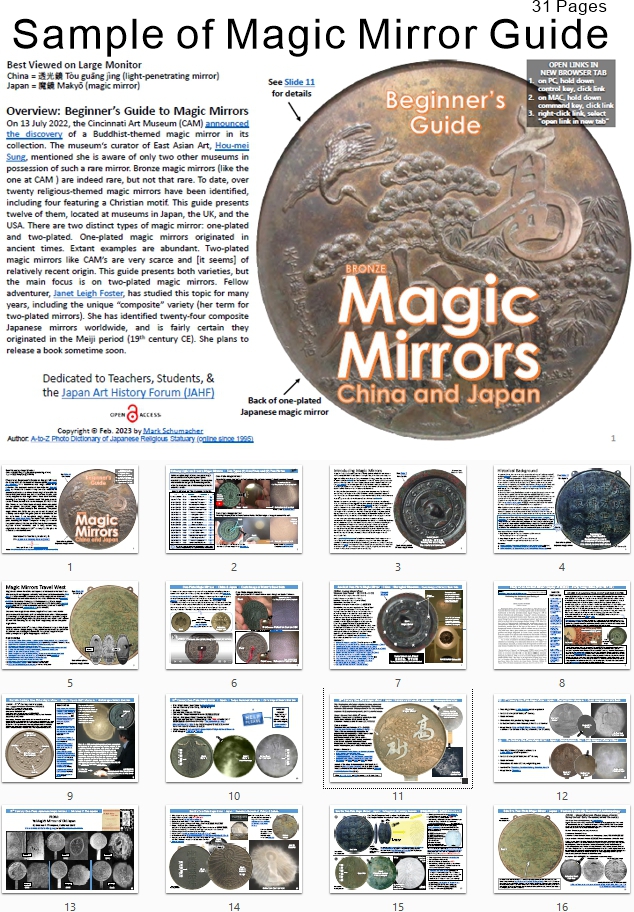
Jump directly to the Magic Mirror Guidebook. On 13 July 2022, the Cincinnati Art Museum (CAM) announced the discovery of a Buddhist-themed magic mirror in its collection. The museum’s curator of East Asian Art, Hou-mei Sung, mentioned she is aware of only two other museums in possession of such a rare mirror. Bronze magic mirrors (like the one at CAM ) are indeed rare, but not that rare. To date, over twenty religious-themed magic mirrors have been identified, including four featuring a Christian motif. This guide presents twelve of them, located at museums in Japan, the UK, and the USA. There are two distinct types of magic mirror: one-plated and two-plated. One-plated magic mirrors originated in ancient times. Extant examples are abundant. Two-plated magic mirrors like CAM’s are very scarce and [it seems] of relatively recent origin. This guide presents both varieties, but the main focus is on two-plated magic mirrors.
Click above image to jump to Beginner’s Guide to Magic Mirrors. █ KEYWORDS. 透光鏡・魔鏡・平原遺跡・三種の神器・古鏡記・王度・三角縁神獣鏡・南无阿弥陀佛・南無阿彌陀仏・念佛・天下一・見日之光・天下大明・踏み返し鋳造法・山本合金製作所.
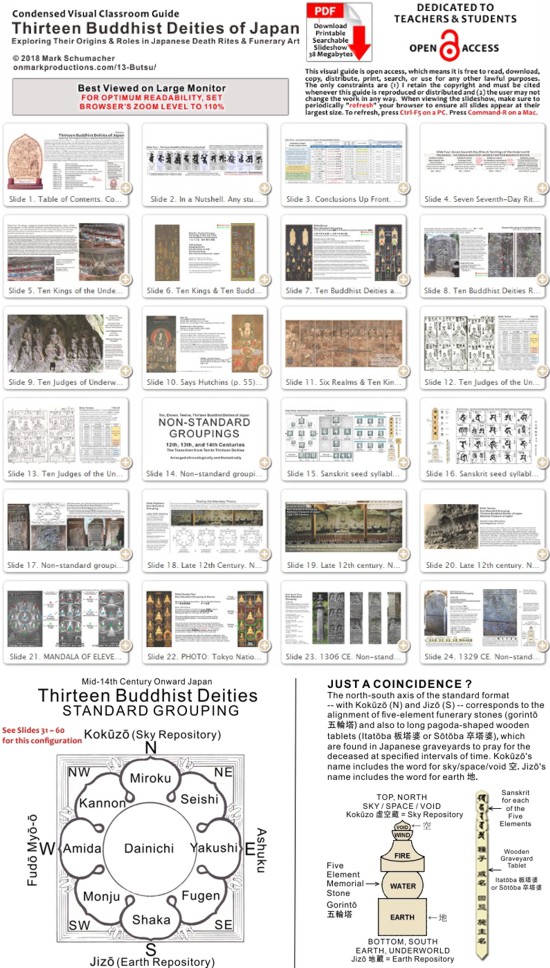
Jump directly to the Condensed Visual Classroom Guide to Japan’s Thirteen Buddhist Deities.The Thirteen Buddhist Deities (Jūsanbutsu 十三仏) are a purely Japanese convention. The standardized group of thirteen emerged in the mid-14th century, but in its formative years (12th & 13th centuries), the group’s composition varied significantly and included only ten, eleven, or twelve members. The group is important to all schools of Japanese Buddhism. Even today, the thirteen are invoked at thirteen postmortem rites held by the living for the dead, and at thirteen premortem rites held by the living for the living. As shown herein, the thirteen are associated with the Seven Seventh-Day Rites 七七斎, the Six Realms of Karmic Rebirth 六道, the Buddhas of the Ten Days of Fasting 十斎日仏, the Ten Kings of Hell 十王, the Secret Buddhas of the Thirty Days of the Month 三十日秘仏, and other groupings. The Thirteen provide early examples of Japan’s medieval honji-suijaku 本地垂迹 paradigm, wherein local deities (suijaku) are recognized as avatars of the Buddhist deities (honji). This classroom guide is unique in three ways: (1) it presents over 70 annotated images, arranged chronologically and thematically, from the 12th to 20th century; (2) it offers four methods to easily identify the individual deities; and (3) it provides visual evidence that the thirteen are configured to mimic the layout of the central court of the Womb World Mandala 中台八葉院. █ KEYWORDS. 十三仏 or 十三佛・十王・七七斎・七七日・中有・中陰・六齋日・六道 ・十斎日仏・三十日秘仏・本地垂迹 ・兵範記・中有記・ 預修十王生七経 ・地蔵十王経 ・佛説地藏菩薩發心因縁十王經・弘法大師逆修日記事 ・下学集. █ An Adobe PDF version (printable, searchable) is also available for download.
Condensed Visual Classroom Guide to Japan’s Thirteen Buddhist Deities
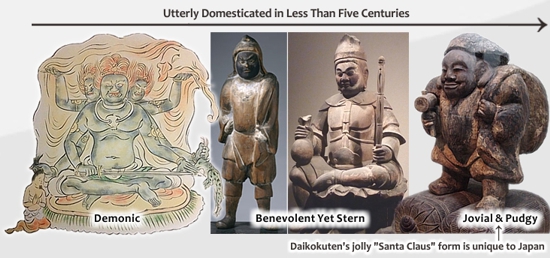
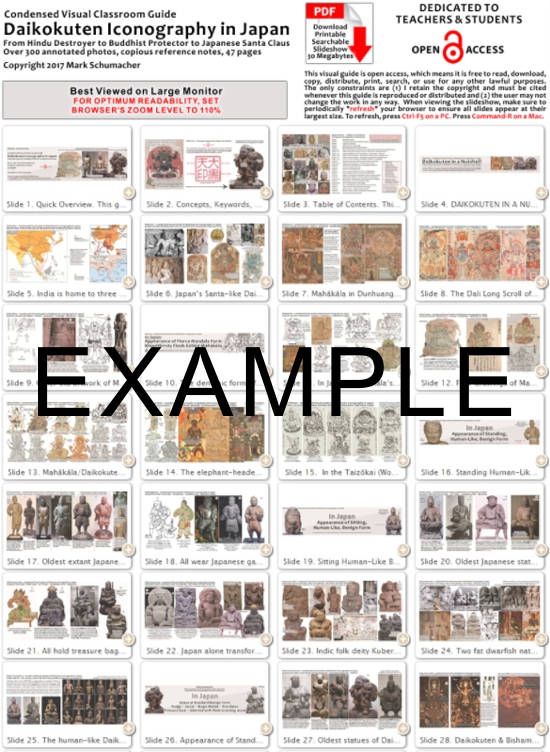
The main goal of Condensed Visual Classroom Guide — Daikokuten Iconography in Japan is to illustrate “visually” Japan’s taming of a demonic, bloodthirsty, flesh-eating, multi-limbed Vedic / Indic / Hindu deity. Today, this Hindu deity (Mahākāla, a “terrible” form of Śiva) is portrayed as a harmless, human-like, potbellied, jolly fellow in Japan’s religious pantheon. His Japanese name is Daikokuten. Today Daikokuten remains one of Japan’s most popular gods of good fortune (e.g., abundant harvests, well-stocked kitchens, lucrative livelihoods). In his standard modern form – portly, dwarfish, jovial, wearing a hat, holding a treasure sack, traveling everywhere to dispense fortune to the people – he is strikingly similar to the Christian world’s Santa Claus. The second goal is to underscore the strong influence of India (rather than China) on Japan’s pantheon of gods. In many ways, the religious landscape in Japan is more akin to Japanese Hinduism than to Chinese Buddhism. The third goal is to provide scholars, art historians, curators, teachers, & students with a “jumpstart” visual guide to the richness & dynamic complexity of Japan’s religious art. Nearly two millennium of Śiva artwork is organized chronologically & thematically herein. Given space limits, the guide’s “visual canvas” includes art from only India, Central Asia, China, & Japan. Center stage is given to Japanese art from the 9th to 21st centuries.